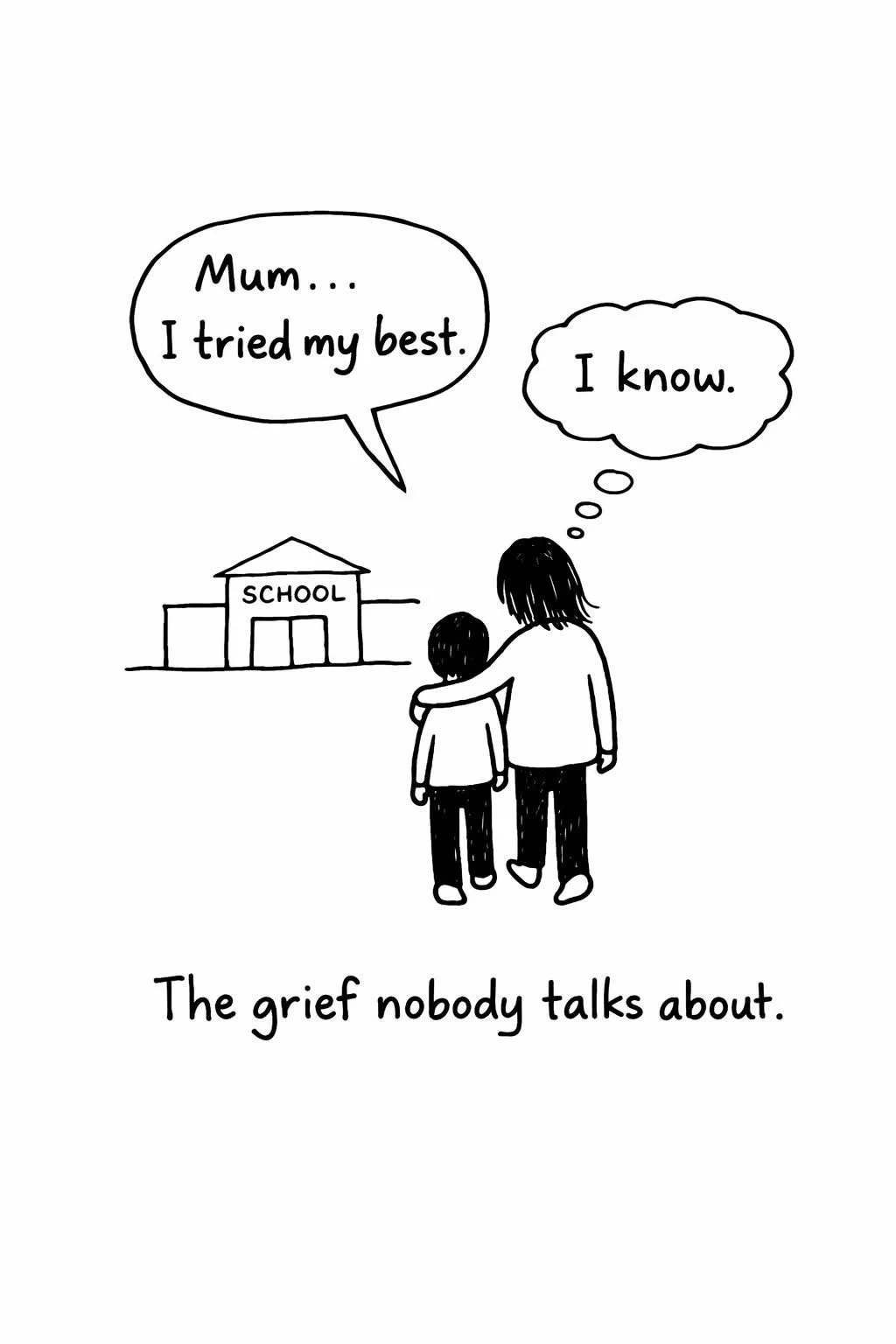
Neurodivergent? The grief we don't talk about.
There’s a kind of grief around neurodivergence that people don’t often talk about.
Not because we don’t love neurodivergent minds.
Not because we don’t see the brilliance.
But because the world still has a very narrow idea of what success is supposed to look like.
Exam results.
Top sets.
Predicted grades.
University pathways.
A constant language of “achievement”.
And if you don’t fit neatly into that system, it can leave a mark.
I know that feeling personally.
At school I struggled to revise and learn the way other people seemed able to. I could understand things, think deeply about things, talk about things, yet when it came to sitting down and revising or showing it on paper, something just didn’t work the same way.
From the outside people saw an intelligent person.
Which meant the response was often:
“Just get on with it.”
“You’re making a fuss.”
“You’re capable, stop overthinking.”
When people think you’re intelligent but you’re struggling anyway, the assumption is that you’re not trying hard enough.
That’s where the shame creeps in.
Because how do you explain something you can’t fully explain yourself?
How do you put words to the frustration of knowing your brain works… just not always in the way the system expects?
Processing speed matters in exams.
The bell rings before the work is finished.
The test ends before the thoughts are fully down on paper.
The class moves on while your brain is still carefully piecing together step one.
So you try harder.
You push.
You mask.
You pretend you’re fine.
And often you carry that quiet feeling of being less than, even when you know deep down that isn’t true.
When I speak to parents of neurodivergent children now, I sometimes see a very particular emotional landscape.
They adore their child. They see their strengths, their creativity, their kindness, their unique way of seeing the world.
But alongside that pride there can also be a quiet ache.
Because the world keeps measuring success using a ruler that was never designed for their child’s mind.
So when other families are celebrating top grades, scholarships and academic prizes, sometimes the celebrations look different.
You celebrate resilience.
You celebrate perseverance.
You celebrate the courage it takes to walk back into school tomorrow and try again.
Those things rarely appear on certificates.
And sometimes when you want to proudly show a piece of work your child has done, there’s that tiny pause inside.
Because comparison sits in the room even when nobody says a word.
For some parents there’s another layer too.
They recognise pieces of their own childhood in what their child is experiencing. The same struggles. The same misunderstandings. The same comments about “trying harder”.
When we hold our babies for the first time, we quietly hope the world will be kinder to them than it was to us.
That school will understand them better.
And when the same patterns start appearing, that can bring its own kind of ache.
Psychology actually has words for these emotional spaces.
One is ambiguous loss, a type of grief where nothing has physically gone, but expectations or imagined futures shift over time.
Another is chronic sorrow, which describes waves of sadness that come and go across the years, often triggered by moments like exam seasons, school reports or parents’ evenings.
Both can sit alongside enormous love and pride.
Because these feelings are not opposites.
You can love someone completely as they are.
And still feel sadness about the systems they have to navigate.
I also know now that the things I once felt ashamed of weren’t flaws.
They were differences.
And those differences shaped the work I do today, the patience I have with people, the curiosity about how minds work, and the refusal to reduce someone’s worth to a grade or a neat definition of success.
Our children, and the adults they become, are not the problem.
The problem is a world that still struggles to recognise intelligence, creativity, empathy and resilience when they appear in forms it didn’t expect.
And one day, hopefully, we’ll learn to measure those things too.
Stay safe, stay connected & take gentle care
Louise x
If this resonates, you’re not on your own.
Pull up a chair.
I've got you.
If you’re tired of carrying it alone, I’m here.
We can take it at your pace. No pressure. No fixing. Just space to be human.
📧 louisemalyancounselling@gmail.com
🌐 www.wildfirecounsellingtherapy.co.uk
Free, no-obligation intro chat, just to see if we’re the right fit.