What Therapy Really Costs (And Why the Hour Myth Misses the Point)
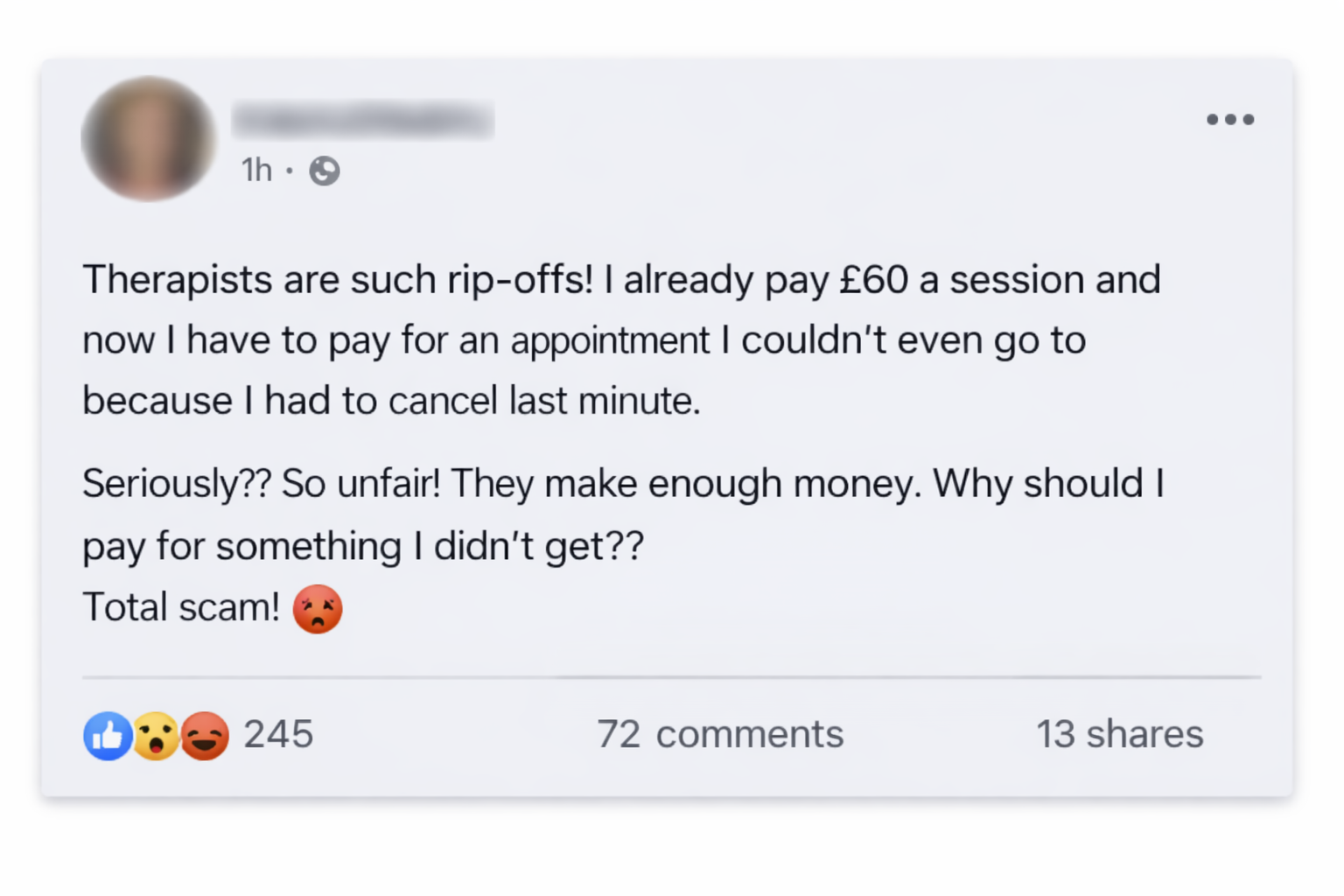
There’s a common assumption about therapy that I hear again and again. Only today I read a post about the cost and laying into a therapist for their fee.
People often think therapists are earning an hourly fee, back-to-back, all day, every day. That we work 37.5 or 40 hours a week in paid sessions and go home comfortable, well-rested, and financially cushioned. To be quite frank, thats bull shit and simply not true!! If only! A girl can dream!!!
Jokes aside…..That isn’t how this work looks in reality.
So I want to gently pull back the curtain and explain what actually goes into therapy, not defensively, not to justify myself, but to educate and bring some reality to a picture that’s often wildly misunderstood.
When you pay for a therapy session, you are not paying for just that hour.
You are paying for the skills, the years of training, the ongoing learning, the infrastructure that keeps the work ethical and safe, and the unseen hours that support the moment you sit down and are held properly.
Before I ever see a client, I pay to exist professionally. I am registered with two professional membership bodies. I pay for insurance. I pay to be listed on three directories, not for vanity, (i rarely even get referrals from them, its all word of mouth) but so that if someone searches my name, they can see that my training is legitimate, my practice is accountable, and I am who I say I am.
I attend my own therapy and supervision as a non-negotiable ethical requirement. I have 90 minutes of clinical supervision twice a month, alongside weekly peer supervision. This is where client work is reflected on, safeguarded, and held responsibly. Supervision is paid for, and rightly so.
Alongside that, I read and train every single week as standard. Often, a client’s presentation means I will do additional, specific learning to make sure I’m working in the most informed and appropriate way for them. That learning costs both time and money.
Books, resources, creative materials, and therapeutic tools don’t magically appear. I’ve built a library and a studio of resources over years, and I am constantly adding to it so I can work flexibly, creatively, and safely with whatever a client brings.
Then there are the business realities.
I pay business rates. I pay for my website. I pay for the cost of holding sessions. I wash blankets daily and keep a constant fresh supply. I provide hot and cold drinks as standard. I pay the ICO. I pay an accountant. I keep up with regulatory changes, ethical updates, and best practice.
From every pound I earn, around 30p is immediately put aside for tax. That money is not mine. It also doesn’t cover holidays or sickness.
As a self‑employed therapist, if I don’t work, I don’t get paid, but all of the above still needs paying. Rent, bills, insurance, supervision, memberships, and life costs don’t pause if I’m ill.
This is why I also have to put money aside in case I’m unwell. There is no sick pay. No paid holiday. No pension contributions made for me. In previous employed roles, I had all of that. Self‑employment is not the financial freedom people often imagine.
Leaving unpaid slots isn’t a neutral choice. If I hold a session that isn’t paid for, I lose income while still covering all costs, which I just cannot afford to do, and someone else who may have needed that space may have been turned away. That’s why I ask for payment at booking, with a 24‑hour grace period. I believe that’s kind, fair, and realistic.
It’s also about accountability. People are far less likely to not attend when a session is paid for. If something is cancelled last minute, I use discretion and will move it within the same week if I genuinely can. If I can’t, I can’t, and that session remains paid for, with the next one needing payment as normal.
I work with complex trauma and very heavy material. That work matters deeply to me, but it also means I can only see a certain number of clients safely. Burnout isn’t an option, for me or for the people I work with.
I also choose to give back.
I heavily discount sessions for students, because that was once offered to me and I want to support. I offer discretionary free Rewind therapy for veterans. I provide concessions at significantly reduced rates for people who genuinely cannot afford extras in life. But if someone can afford things like holidays, takeaways, and non‑essential spending, therapy is charged at full price, because it is a priority, not a luxury add‑on. I trust that clients tell me the truth. I don’t ask for proof. I believe what they tell me and meet them where they are at. I only have so many sessions, so trust my clients. They know how I work, so if a situation changes, they can come to me & we can look at options. And yes, they do tell me when financial situations improve. Thats how valuable therapy is to them and how much they respect it. (I have amazing clients at whatever they pay.) I also will always endeavour to support clients who fall on difficult times. This work is so important. If I can, I will.
It cost me over £35,000 to do my basic initial training.
Four years of counselling training, and an additional two years where I studied and gained my counselling degree. Then in addition to my basic initial training I have completed numerous and robust Trauma trainings. Creative interventions. Group facilitation. Couples work. Clinical supervision. Inner child. Neurodivergence. Sexual violence. Children & young people. Personality disorders. Single‑session and solution‑focused qualifications. And the learning has never stopped, and never will.
I work hard. Bloody hard.
I am not coining it in.
Last year, I had unexpected time off in a year where I couldn’t afford a holiday. Then Christmas arrived, and I couldn’t work at capacity, its an enforced break!! I’m still doing my best to recover financially from that.
There are also the quieter costs: internet, phone, devices, secure systems, Zoom, software, all essential, all ongoing.
So when people ask about the cost of therapy, or assume therapists earn that hourly rate all day long, this is the fuller picture.
One session often carries hours of unseen work and continued learning behind it. Not because we’re forced to do it, but because we care. Because we’re passionate. Because we want to offer the very best we can to the person sitting in front of us.
I’ve won awards I barely talk about. That’s not what this is about. I dont need an award to tell me I am good at what I do. My work speaks for itself.
This work is about integrity. Presence. Skill. Safety. And offering something deeply considered and human.
Therapy is not expensive.
It is valuable.
And the people who do this work are not charging for an hour, they are holding a whole profession, a whole life of learning, and a whole lot of responsibility so you don’t have to do it alone.
This isn’t written to defend fees or justify worth.
It’s written to invite understanding, for clients, and for therapists alike.
For clients: your commitment to showing up, investing in yourself, and doing the work matters.
For therapists: the care, skill, restraint, boundaries, and invisible labour you bring every day matters.
Both sides of the room are doing something brave here.
Stay safe, stay connected, take gentle care,
Louise x
Disclaimer: The accompanying image is illustrative only. It is not taken from a specific client or identifiable individual. It reflects common themes seen across multiple public posts and is used solely for the purposes of education and discussion within this blog.
And the cake….a good old post Christmas yellow label!!!