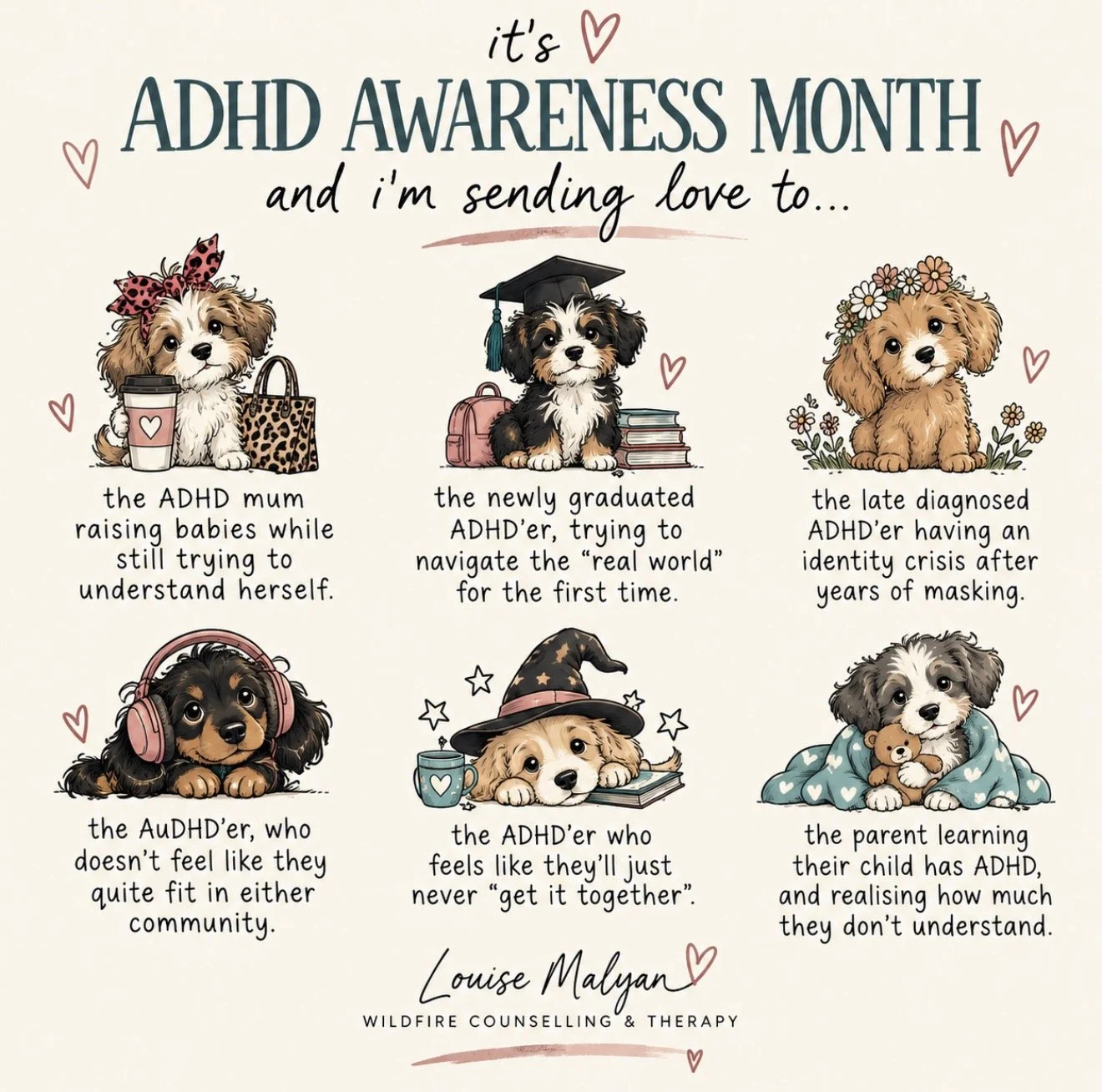
ADHD Awareness Month: What If You Were Never the Problem in the First Place?
Have you ever spent your entire life feeling like everybody else was given an instruction manual for being human, and yours got lost in the post?
Because I have. 😂
For years, I couldn’t understand why things that seemed so straightforward for other people could feel ridiculously difficult for me.
Why I could manage enormous responsibilities, deal with emergencies, think quickly under pressure and hold everything together when things went wrong, yet struggle with something as ordinary as putting the washing away or spmeone changing plans on me.
Why I could remember the tiniest detail of a conversation from years ago, yet walk into a room and have absolutely no idea what I’d gone in there for.
Why I could be incredibly capable one day and completely overwhelmed the next.
Why I felt things so deeply.
Why rejection, criticism or somebody’s change in tone could send my brain into a full investigation worthy of the Metropolitan Police.
And why, despite everything I’d achieved, there was always that little voice asking:
What’s wrong with me?
October is ADHD Awareness Month, and I want to talk about the bits of ADHD that don’t always make it onto the colourful infographics.
The bits that can be funny, frustrating, exhausting, heartbreaking and sometimes all four before breakfast.
Because ADHD isn’t simply forgetting your keys or getting distracted by a squirrel.
Although, to be fair, I do love a good squirrel. 😂
The exhausting business of trying to be normal
One of the things I hear so often from people with ADHD is:
“I’ve spent my whole life trying to fit in.”
And I understand that.
You watch other people.
You notice how they behave, what they say, how they organise themselves, how they manage friendships, how they seem to know the right thing to do.
Then you try to copy it.
You learn to hide the things that get criticised.
Perhaps you stop interrupting, even though you’re terrified you’ll forget what you wanted to say.
You rehearse conversations.
You pretend you’ve understood instructions when you haven’t.
You laugh when somebody calls you scatty.
You apologise for being late, emotional, forgetful, messy or too enthusiastic.
You become very good at appearing okay.
And sometimes you become so good at pretending that you lose track of who you actually are.
That’s masking.
It can help us navigate situations where being different hasn’t felt safe or accepted.
It can also be bloody exhausting.
Because imagine spending every day monitoring yourself.
Am I talking too much?
Have I said something stupid?
Do they like me?
Am I being annoying?
Have I forgotten something?
Why can’t I do this properly?
And then wondering why you’re exhausted when you’ve apparently done very little.
Sometimes the effort is happening where nobody can see it.
Late diagnosis: relief, grief and a whole lot of questions
For some people, receiving an ADHD diagnosis later in life is wonderful.
Suddenly things make sense.
There’s a reason certain things have always been difficult.
There’s language for experiences you’ve never been able to explain.
You discover other people whose brains work in similar ways.
And you might think:
Oh my goodness. There are more of us!
Then sometimes comes the grief.
What if somebody had recognised this when I was younger?
What if I’d received support instead of criticism?
What if I’d understood myself before spending years believing I was lazy, stupid, difficult or broken?
What if I’d made different choices?
And then there’s the identity question.
If I’ve spent decades trying to be the person everybody expected, who am I underneath all of that?
Not everybody experiences diagnosis in the same way.
Some feel relieved. Some feel angry. Some feel sad. Some feel absolutely nothing for a while.
Some don’t want a diagnosis at all.
And some are still trying to access an assessment.
There’s no correct emotional response.
I personally feel proud of understanding my ADHD.
Not because it makes everything easy.
Because it has helped me stop fighting myself quite so much.
ADHD and the emotional stuff nobody warned you about
Let’s talk about emotions.
Because ADHD can involve difficulties with emotional regulation, although everybody experiences that differently.
For some people, feelings arrive with the volume turned up.
Excitement can be enormous.
Joy can be wonderful.
Frustration can feel unbearable.
And perceived rejection?
Oh, that can be quite the experience.
You send somebody a message.
They reply:
“Okay.”
That’s it.
One word.
Your brain, meanwhile, has opened seventeen tabs.
Are they annoyed?
Did I say something wrong?
Why didn’t they use an emoji?
They normally use an emoji.
Maybe they don’t like me.
Perhaps I’ve upset them.
Should I apologise?
What for?
I DON’T KNOW, BUT PERHAPS I SHOULD APOLOGISE ANYWAY.
😂
Rejection sensitive dysphoria, often called RSD, is a term many ADHDers use to describe particularly intense emotional pain around perceived rejection or criticism.
It isn’t a separate formal diagnosis, and it doesn’t affect everybody with ADHD.
Yet the experience can be very real.
And sometimes it’s connected to years of actually being criticised, excluded, misunderstood or told we’re too much.
So in therapy, I don’t want to simply tell somebody they’re overreacting.
I want to understand what’s happening.
What did that interaction mean to you?
What did your brain predict was going to happen?
Does it remind you of something?
What happens in your body?
What helps you feel safe enough to respond rather than react?
Your feelings deserve understanding. And we can still get curious about what you do with them.
Why can I do something incredibly complicated and not something simple?
This is one of my favourite ADHD contradictions.
Give me a complicated situation, something urgent, interesting or challenging, and my brain may absolutely love it.
Ask me to complete a boring administrative task with no immediate deadline?
Suddenly cleaning the fridge seems fascinating.
ADHD can affect executive functions, including planning, starting tasks, organising, remembering information, managing time and switching between activities.
And it isn’t always consistent.
That’s what can make it so confusing.
Because you did it yesterday.
So why can’t you do it today?
Because you’re not a machine.
Your capacity can change with sleep, stress, interest, environment, hormones, emotional demands and a whole host of other things.
And knowing how to do something isn’t always the same as being able to get started.
That’s why telling somebody with ADHD to buy a planner, make a list or try harder can be spectacularly unhelpful.
Some of us have enough planners to open a stationery shop.
Beautiful planners.
Colour-coded planners.
Planners with stickers.
Planners we used enthusiastically for four days before forgetting they existed.
I speak from experience. 😂
The answer isn’t necessarily another planner.
Sometimes it’s changing the environment.
Making the task smaller.
Using visual reminders.
Having somebody alongside you.
Reducing decisions.
Finding ways to make something interesting.
Or accepting that the method everybody else uses simply isn’t the right method for you.
Different doesn’t automatically mean wrong.
ADHD, relationships and feeling misunderstood
ADHD doesn’t happen in isolation from the people around us.
It can affect relationships.
Perhaps your partner thinks you’re not listening.
You are listening. You’ve also noticed a noise outside, remembered something you forgot to do and started wondering whether the dog needs feeding.
Perhaps you forget something important and your partner experiences that as not caring.
Perhaps you become overwhelmed during disagreements.
Perhaps criticism feels so painful that you become defensive before you’ve even understood what’s being said.
Perhaps your partner feels they’re carrying too much of the practical responsibility.
And perhaps you feel constantly criticised for things you’re genuinely trying to manage.
Both experiences matter.
ADHD can help explain certain difficulties.
It doesn’t mean somebody else’s feelings stop mattering, and it doesn’t mean you’re deliberately causing problems.
This is where curiosity can make an enormous difference.
Instead of:
“Why can’t you ever remember anything?”
What about:
“What would help us remember this without either of us feeling like a parent or a child?”
Instead of:
“You never listen.”
Perhaps:
“Can we work out a way of having important conversations that helps us both feel heard?”
Understanding isn’t the same as making excuses.
It’s finding a way forward that works for the people actually in the relationship.
ADHD and addiction: when something finally quietens the noise
This is an area particularly close to my heart, personally and professionally.
Some people with ADHD develop difficulties with alcohol or other substances.
Not everyone does, of course.
And addiction is never explained by one thing alone.
Yet ADHD can increase vulnerability to substance-use problems, and sometimes people describe using alcohol or substances to manage restlessness, anxiety, social discomfort, emotional pain or the constant noise in their heads.
For some, alcohol can initially feel like relief.
A quieter mind.
Less self-consciousness.
A little break from thinking.
Until it starts costing more than it’s giving.
I’m sober myself.
And one of the things I understand is that changing a relationship with alcohol doesn’t automatically answer every question about why you needed it in the first place.
Sometimes getting sober is when the really interesting work begins.
The feelings are still there.
The overwhelm is still there.
The shame might still be there.
And suddenly you need to discover different ways of being with yourself.
There is no shame in needing help with that.
What about the children?
I wish we could stop assuming that every child who struggles with school, concentration, behaviour or emotions needs to try harder.
Sometimes a child who appears not to be listening is desperately trying to concentrate.
Sometimes the child who explodes after school has spent the entire day holding everything together.
Sometimes the child who can’t get through the school gates is overwhelmed, frightened or exhausted.
Sometimes the child who’s constantly moving is trying to regulate themselves.
And sometimes a child is testing boundaries, being impulsive, having an ordinary difficult day or doing something they know they shouldn’t.
Children are human beings, not walking diagnostic criteria.
ADHD doesn’t explain every behaviour.
Neither should we ignore the possibility that behaviour is communicating a need.
I think one of the most helpful questions we can ask is:
What is happening for this child, and what might help?
Rather than immediately deciding what is wrong with them.
And parents?
You deserve understanding too.
Especially if you’re discovering your child’s ADHD while recognising your own childhood in everything you’re learning.
That can bring up a lot.
You don’t have to love having ADHD
I see a lot of pressure for neurodivergent people to celebrate their brains.
And I understand where that comes from.
For years, difference has been treated as something to correct.
There’s enormous value in recognising strengths, creativity, humour, curiosity, enthusiasm and different ways of thinking.
I love many things about how my brain works.
And there are days when it drives me absolutely round the bend.
Both can be true.
You can be proud of being neurodivergent and still find aspects of ADHD disabling.
You can enjoy your creativity and struggle with overwhelm.
You can love your enthusiasm and wish you could switch your thoughts off sometimes.
You can accept yourself and still want support.
Acceptance doesn’t mean pretending everything is wonderful.
It means being able to look at yourself with a little more understanding and a little less judgement.
So how can therapy or ADHD coaching actually help?
This is where I think we need to move away from the idea that there’s one correct way to manage ADHD.
Because there isn’t.
I work as a psychotherapist counsellor and ADHD coach, and I bring my professional knowledge alongside my own lived experience.
I’m also very aware that my ADHD isn’t your ADHD.
What works for me might be completely useless for you.
And that’s okay.
We can explore the emotional stuff.
The shame.
The masking.
The years of feeling not good enough.
The anxiety, trauma, relationships, rejection sensitivity, addiction, burnout and identity questions.
We can also look at the practical stuff.
Managing overwhelm.
Understanding patterns.
Finding ways to start tasks.
Creating routines that suit your life.
Learning to recognise when you’re reaching capacity.
Communicating your needs.
Working out what actually helps rather than what you think should help.
And we don’t have to do it all sitting and talking in a traditional way.
We can use creativity, visual approaches, practical exercises, reflection, humour and whatever helps you engage with the work.
Sometimes we’ll try something and discover it’s completely wrong for you.
Wonderful.
We’ve learnt something.
You haven’t failed. We’ve found something that doesn’t fit.
Then we try something else.
Because my job isn’t to turn you into somebody who is brilliant at doing therapy my way.
It’s to work alongside you to discover what helps you.
One last thing for ADHD Awareness Month
If you’ve spent years feeling different, misunderstood, overwhelmed or not good enough, I hope this month brings you something more meaningful than a few social media posts.
I hope it brings understanding.
Perhaps a conversation.
Perhaps the courage to ask for an assessment.
Perhaps the realisation that you’re allowed to ask for help even without a diagnosis.
Perhaps a little more compassion for the younger version of you who was trying so hard.
And perhaps the beginning of a different relationship with yourself.
You don’t have to suddenly love everything about your brain.
You don’t have to become organised, calm, productive and emotionally regulated every minute of the day.
You don’t have to prove your ADHD is a superpower.
And you don’t have to spend the rest of your life apologising for being different.
What if, instead of spending another year trying to become somebody else, you started getting curious about who you actually are?
That’s a conversation I’d love more people to have.
And if you’d like some help having it, I’d be happy to meet you.
I offer a free 15–20 minute intro call via WhatsApp video, with absolutely no obligation to book. It’s a chance to ask questions, tell me a little about what’s happening and see whether I might be your person.
You can find out more about my therapy and ADHD coaching at:
www.wildfirecounsellingtherapy.co.uk
Email: louisemalyancounselling@gmail.com
WhatsApp: 07540 843727
Stay safe, stay connected.
Take gentle care,
Louise x
Louise Malyan
Psychotherapist Counsellor, ADHD Coach and a woman with an ADHD brain of her own.