World Mental Health Day, ADHD Awareness Month and the Changing Seasons: Can We Get a Little More Curious About Each Other?
It’s October. The weather’s changing, the clocks will soon be going back, it’s ADHD Awareness Month, today is World Mental Health Day, and my perimenopausal ADHD brain is wondering what on earth is going on. 😂
One minute I’m enjoying the autumn colours, cosy jumpers and the thought of snuggling up with the dogs.
The next I’m wondering why I’m absolutely exhausted, why my concentration has disappeared and whether I’m too hot, too cold or somehow both.
And that’s got me thinking.
Not necessarily about what’s wrong with us.
More about how often we forget to get curious about what’s happening to us.
Because we’re human beings.
Not machines.
And our mental health doesn’t exist separately from our bodies, relationships, hormones, environments or the things we’ve experienced.
October has got quite a lot going on!
Today, 10th October, is World Mental Health Day.
October is also ADHD Awareness Month.
And here in the UK, we’re heading into those shorter, darker days when the temperature drops, the daylight changes and our routines start shifting.
For some people, autumn is wonderful.
For others, it’s the beginning of a really difficult time of year.
And some of us love the idea of autumn while finding the actual transition rather challenging.
I think that’s worth talking about.
Because when somebody says they’re struggling, how often do we jump straight to trying to fix it?
“Get outside more.”
“Go to bed earlier.”
“Try exercising.”
“Have you tried a planner?”
Now, some of those things might genuinely help.
And perhaps we could start by asking a different question.
What’s happening in your world at the moment?
The weather changes. And sometimes so do we.
Have you ever noticed how differently you feel depending on the time of year?
Perhaps you feel more energised when the sun is shining.
Perhaps you love the darker evenings because they give you permission to slow down.
Or perhaps you dread them.
Less daylight can affect our sleep-wake rhythms, energy and mood. Some people experience seasonal affective disorder, while others notice smaller changes that still affect their everyday lives.
And then there are the practical things.
Getting up when it’s dark.
Leaving work when it’s dark.
Children adjusting to new school routines.
More time indoors.
Less spontaneous socialising.
Cold, wet mornings when getting out of bed feels like an Olympic event.
For somebody already struggling with anxiety, depression, ADHD, burnout or grief, those changes can feel significant.
And yet we can be so quick to criticise ourselves.
“Why can’t I get motivated?”
“Why am I so tired?”
“Why was I managing last month and now everything feels difficult?”
Perhaps instead of immediately deciding we’re failing, we could get curious about what has changed.
ADHD doesn’t suddenly disappear because we’ve bought a new diary.
As somebody with ADHD, I know how frustrating it can be when your brain doesn’t seem to cooperate with your intentions.
You can genuinely want to do something.
Know how to do it.
Understand why it’s important.
And still struggle to get started.
Then add a change in routine, disrupted sleep, darker mornings or increased demands.
Things that were already taking effort can become even harder.
ADHD can affect attention, planning, working memory, emotional regulation and our ability to manage everyday tasks.
And it doesn’t look the same in everybody.
Some people are visibly restless.
Others appear quiet and organised while working incredibly hard behind the scenes to keep everything together.
Some have spent years being described as lazy, careless, dramatic, disorganised or too sensitive.
And some have spent decades believing those descriptions.
That’s one of the reasons I think ADHD Awareness Month matters.
Not simply so people recognise a list of symptoms.
So we can begin questioning the assumptions we make about behaviour.
Because what looks like somebody not trying might actually be somebody trying harder than anyone realises.
And then there’s perimenopause. Oh, the joy! 😂
Now here’s something I wish we’d spoken about more openly years ago.
Perimenopause.
Because for some women, it’s not simply hot flushes and irregular periods.
Changes in hormones can affect sleep, mood, concentration and memory.
And if you already have ADHD, those changes can make existing difficulties feel more noticeable or harder to manage.
Imagine spending years learning how your brain works, finding strategies that help, finally feeling a little more comfortable in yourself…
And then suddenly wondering why the strategies that worked last year aren’t working quite so well now.
You might feel more forgetful.
More emotionally reactive.
Less able to tolerate noise or interruptions.
More overwhelmed by things you previously managed.
And then there’s the frustration of wondering whether it’s ADHD, perimenopause, poor sleep, stress or some wonderful combination of the lot.
Sometimes there isn’t one neat answer.
That’s why I think we need to be careful about assuming every experience has one explanation.
And why it’s worth talking to an appropriately qualified healthcare professional about new or changing symptoms, rather than dismissing everything as hormones or ADHD.
Men and women aren’t necessarily experiencing the same things.
And I don’t mean that every man is one way and every woman is another.
We’re far more complicated and interesting than that.
I’m talking about how biology, hormones, upbringing, social expectations and life experiences can influence the way we experience and express distress.
Think about the messages many boys grow up hearing.
“Man up.”
“Don’t cry.”
“Be strong.”
Now think about the messages many girls grow up hearing.
“Be nice.”
“Don’t make a fuss.”
“Think about everybody else’s feelings.”
Those messages aren’t universal, and they can follow us into adulthood.
Some men learn to hide sadness behind anger, humour, work or withdrawal.
Some women learn to hide exhaustion behind smiling, caring for everybody else and saying they’re fine.
Of course, those patterns can happen to anyone.
And sometimes we become so focused on how somebody is behaving that we forget to wonder what might be happening underneath.
A man who seems angry might be frightened, ashamed or overwhelmed.
A woman who seems irritable might be exhausted, struggling with hormonal changes or carrying an enormous mental load.
A young person who seems uninterested might be anxious, overstimulated or struggling to process what’s expected of them.
And sometimes somebody is angry because they’re angry.
Curiosity isn’t about making excuses for harmful behaviour.
It’s about trying to understand what’s happening while still recognising responsibility and accountability.
We can understand somebody’s pain without accepting being hurt by them.
Both matter.
What if we stopped asking people to prove they’re struggling?
Something I see in therapy is how much effort people put into appearing okay.
They’ll tell me they’re exhausted, overwhelmed, anxious or unhappy.
Then immediately explain why they shouldn’t feel that way.
“Other people have it worse.”
“I’ve got nothing to complain about.”
“I should be grateful.”
“I don’t know why I’m making such a fuss.”
And I wonder where we learned that distress has to be justified before we’re allowed to acknowledge it.
Your mental health doesn’t have to reach crisis point before it deserves attention.
You don’t have to be unable to get out of bed.
You don’t have to have a diagnosis.
You don’t have to be visibly falling apart.
Sometimes noticing that you’re not feeling quite like yourself is enough reason to get curious.
What’s changed?
What are you carrying?
What do you need?
What have you been ignoring because you’ve been too busy looking after everybody else?
And is the way you’re currently coping actually helping you?
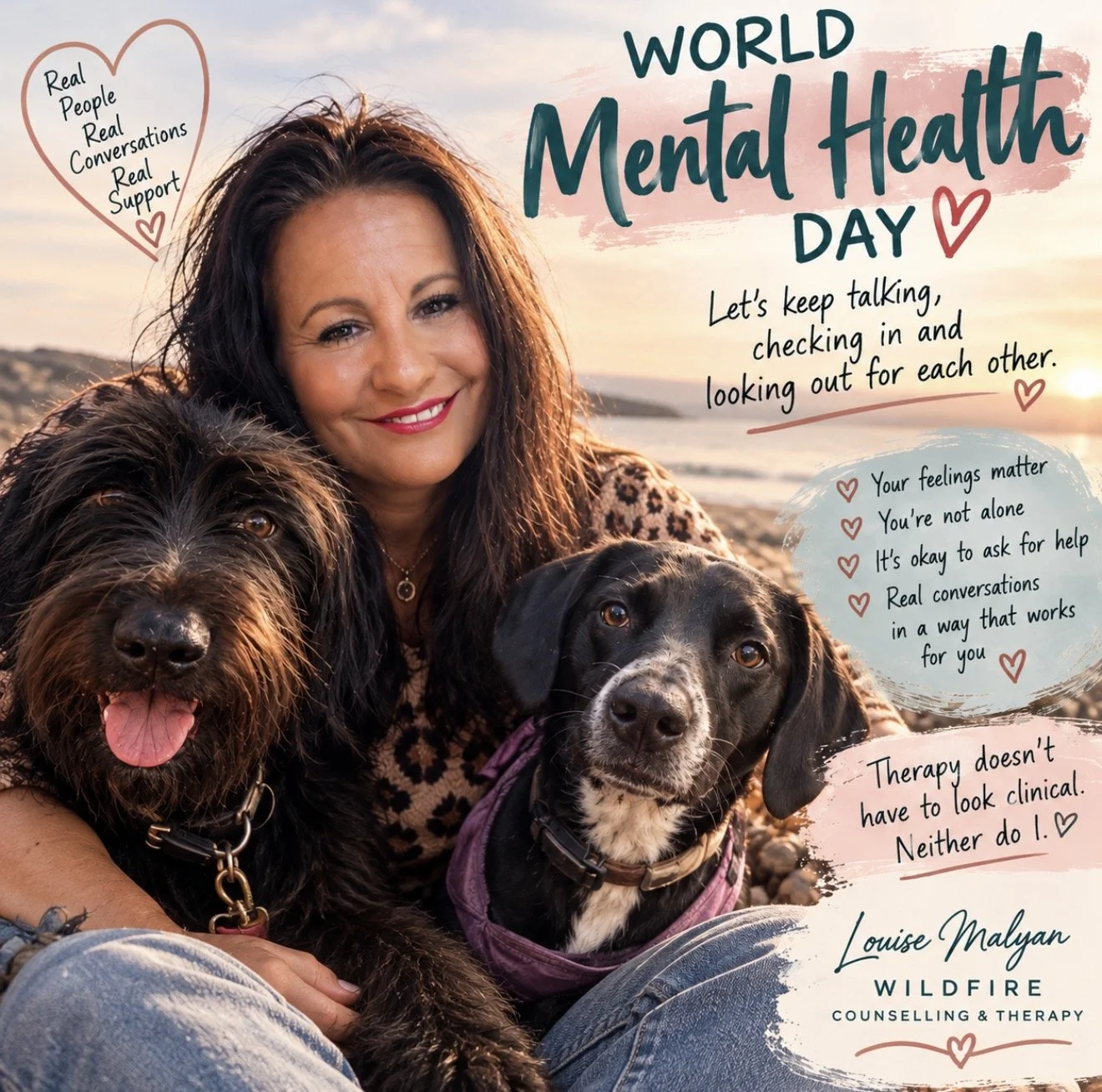
Therapy doesn’t have to look clinical. Neither do I.
If you’ve seen my World Mental Health Day picture, you’ll know I’m not exactly the stereotypical image some people have of a therapist.
There’s leopard print.
There are dogs.
There’s usually a mug of something nearby.
And there’s a human being who has her own experiences, emotions, challenges and wonderfully unpredictable ADHD brain.
I’m not a blank slate.
I’m a qualified therapist who believes the relationship between us matters enormously.
I bring my professional knowledge, training and experience.
And I bring warmth, humour, curiosity and a willingness to work differently.
We might talk.
We might explore things creatively.
We might look at patterns in your relationships, the experiences that shaped you, your inner critic, your emotional responses or the practical challenges of everyday life.
And if something isn’t working for you, we can talk about that too.
You don’t have to fit yourself into my idea of what therapy should look like.
We can explore what works for you.
Because there’s no single way to experience mental health difficulties.
And there’s no single way to find support.
So, on World Mental Health Day, here’s what I’d really like us to remember.
Mental health isn’t something we only need to think about when somebody is in crisis.
It’s part of everyday life.
It changes.
It responds to circumstances.
It can be influenced by sleep, hormones, seasons, relationships, health, trauma, neurodivergence, loss and the pressures we’re living under.
And sometimes we won’t immediately understand why we’re feeling the way we do.
That’s okay.
We can start with curiosity rather than criticism.
We can listen to somebody without immediately trying to fix them.
We can check in on the person who always seems fine.
We can recognise that two people might experience the same situation very differently.
We can take responsibility for our behaviour while being compassionate towards ourselves.
And we can remember that needing support isn’t evidence of weakness.
It’s part of being human.
Perhaps the most useful question we can ask ourselves and each other isn’t “What’s wrong with you?”
Perhaps it’s “What’s happening for you?”
And then actually make space to listen to the answer.
If you’ve been thinking about therapy or ADHD coaching, I offer a free 15–20 minute WhatsApp video introductory call. No pressure, no obligation, simply an opportunity to meet me, ask questions and see whether I might be your person.
🌿 Wildfire Counselling & Therapy
Louise Malyan | Psychotherapist, Counsellor & ADHD Coach
🌐 wildfirecounsellingtherapy.co.uk
📧 louisemalyancounselling@gmail.com
📱 WhatsApp: 07540 843727
Take gentle care,
Louise x