ADHD Awareness Month: When Plans Change and Your Brain Hasn’t Caught Up Yet
Or why “Come on, we’re doing something else now” can feel like somebody’s pulled the rug out from underneath you.
Have you ever been happily doing something, completely absorbed in it, when somebody suddenly announces:
“Right, come on, we’re going now.”
And your entire body seems to respond with…
WHAT? NOW? WHY? WE HAVEN’T FINISHED!
Perhaps you were enjoying yourself.
Perhaps you were halfway through a task.
Perhaps you’d spent the whole morning preparing yourself to do something, only to discover the plans had changed.
And the person telling you seems completely baffled by your reaction.
“What’s the problem?”
“We’re only doing something different.”
“It’s not a big deal.”
“Why do you always make everything so difficult?”
Oh, that last one.
Because sometimes the hardest part isn’t the change itself.
It’s feeling ashamed of how much the change affects you.
And that’s what I want to explore today.
Because for some of us neurodivergent folk, changing direction isn’t always as simple as somebody announcing a new plan.
Our brains might need a little time to catch up.
When everybody else seems able to change direction
Imagine you’ve arranged to spend Saturday afternoon doing something you’ve been looking forward to.
You’ve thought about it.
Planned it.
Perhaps you’ve worked out what time you’re leaving, what you’re wearing, where you’re going and what the rest of your day will look like.
You might not even realise how much mental preparation you’ve done.
And then somebody says:
“Actually, we’re not doing that now. We’re going somewhere else.”
And suddenly you feel it.
That sinking feeling in your chest.
The frustration.
The heat.
The urge to say no.
Perhaps you go quiet.
Perhaps you become irritable.
Perhaps you ask seventeen questions.
Perhaps you snap at somebody you love.
Or perhaps you agree, smile and spend the next hour feeling completely overwhelmed.
And afterwards?
You feel guilty.
Why couldn’t I just go along with it?
Why did I react like that?
Why am I so difficult?
Why can’t I be more spontaneous?
And that shame can sometimes last considerably longer than the change itself.
Let me tell you about tendrils
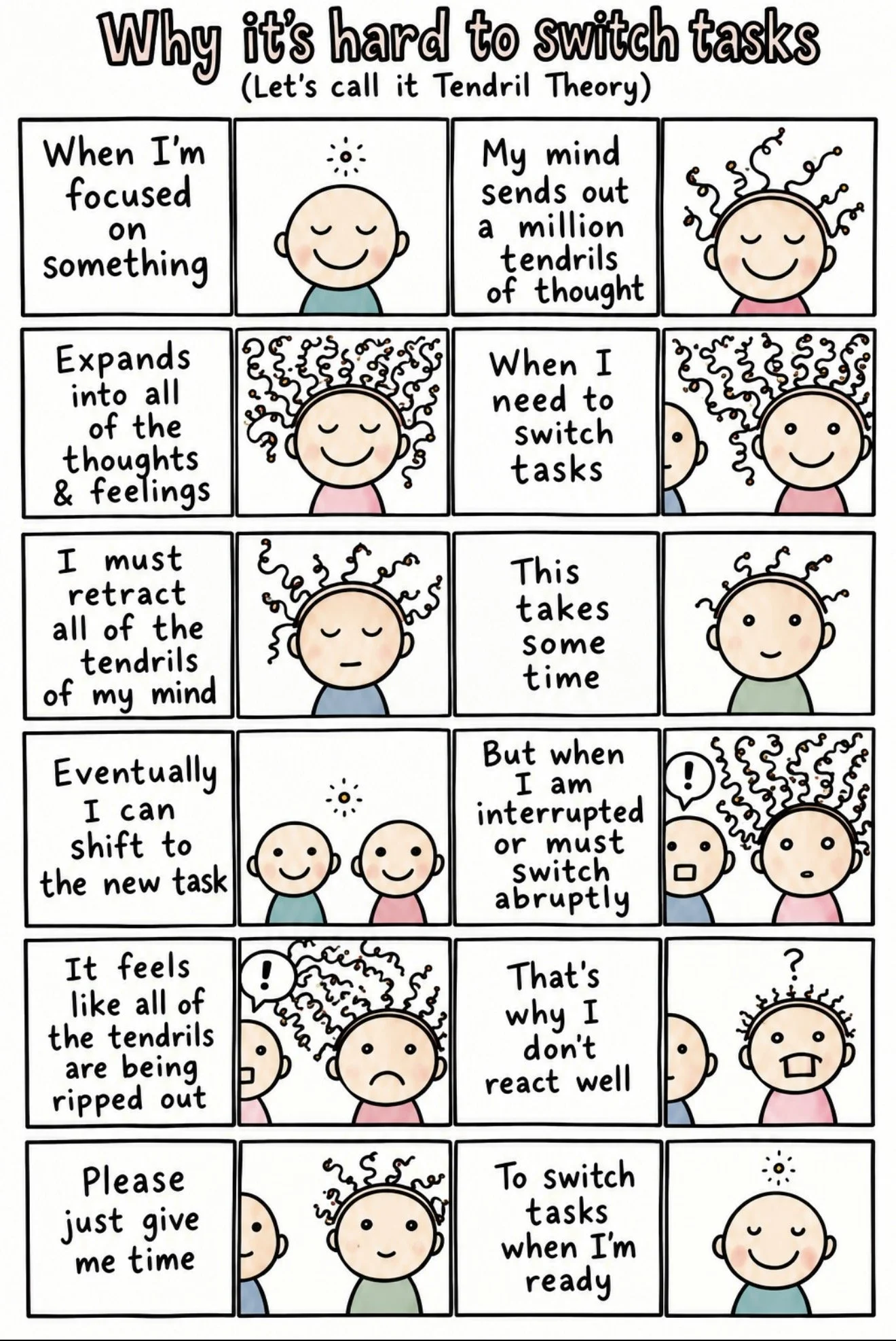
There’s a description of this experience that I really like, often referred to as tendril theory.
It’s a metaphor, rather than a scientific theory, and I think it can be a wonderfully helpful way of explaining something that isn’t always easy to put into words.
Imagine a person with little tendrils growing out from their head.
Every time they begin preparing for something, those tendrils start growing towards it.
You have a task to complete.
Your mind starts connecting with it.
You gather the information you need.
You begin organising your thoughts.
You imagine what you’re going to do.
You work out the steps.
Perhaps you become completely absorbed.
Your tendrils are growing and connecting with that task.
And then somebody says:
“Stop that. We’re doing something else now.”
For the person giving the instruction, it’s a simple change.
For you, it can feel as though all those tendrils have suddenly been pulled out.
Not gently gathered back in.
Not given time to loosen their grip.
Just yanked away.
And now you’re expected to immediately grow a whole new set in another direction.
No wonder that can feel overwhelming.
I love this metaphor because it helps explain something important.
Sometimes we aren’t resisting the new thing. We’re struggling to disconnect from the thing we were already connected to.
And those are not necessarily the same thing.
It’s not always about wanting things our own way
This is where misunderstandings can happen.
A partner might think you’re being controlling.
A friend might think you’re being awkward.
A boss might think you’re unwilling to be flexible.
A parent might think their child is deliberately being difficult.
And sometimes we might even believe those things about ourselves.
Yet there can be a lot happening underneath.
For some autistic people, predictability and routine can be particularly important.
For some people with ADHD, shifting attention, stopping an absorbing activity or reorganising a plan can be difficult.
And for people with both ADHD and autism, there can sometimes be a rather interesting tug of war between wanting novelty and needing predictability.
Of course, everybody’s different.
Some neurodivergent people love spontaneous changes.
Some struggle with certain types of change and not others.
And some find it depends entirely on how tired, overwhelmed or emotionally stretched they already are.
This isn’t about saying neurodivergent people can’t cope with change.
It’s about recognising that the effort involved in changing direction isn’t always visible to somebody else.
And sometimes you can feel it in your whole body
Have you ever noticed what happens physically when plans suddenly change?
Perhaps your chest feels tight.
You get hot.
Your hands or fingers feel strange or tingly.
Your stomach drops.
Your thoughts become fuzzy.
You feel restless.
You want to escape.
You feel like crying.
Or you suddenly can’t find the words to explain what’s happening.
For some people, unexpected changes can trigger a stress response.
And when we’re overwhelmed, our ability to think clearly, communicate and make decisions can become more difficult.
It’s worth remembering that physical sensations can have different causes too. New, severe or unexplained symptoms shouldn’t automatically be put down to ADHD or anxiety.
Yet learning to notice our own patterns can be really useful.
Because sometimes our body gives us clues before we’ve even worked out what we’re feeling.
For example, I might notice I’m becoming irritated.
And instead of immediately deciding I’m being unreasonable, I can get curious.
Hang on. What just happened?
Was I expecting something different?
Have I been interrupted?
Am I struggling to change direction?
Do I need a little time?
That moment of recognition can make a difference.
Not because it instantly removes the feeling.
Because it gives us an opportunity to understand it.
What happens when this affects our relationships?
Imagine you’re spending time with your partner.
You’ve planned a quiet evening.
You’ve mentally settled into the idea.
Then they announce:
“Oh, I’ve invited some friends round.”
They might be delighted.
You might actually like those friends.
Yet suddenly you’re feeling overwhelmed, irritated or anxious.
And your partner can’t understand why.
“What’s wrong? You like them!”
Yes.
You do like them.
And you weren’t prepared for having people in your space tonight.
Or perhaps you’ve planned a day out with a friend.
They change the destination at the last minute.
You become quiet.
They think you’re sulking.
You feel misunderstood.
They feel rejected.
And before you know it, you’re both upset about something that neither of you intended to turn into an argument.
Sometimes these experiences can create patterns in relationships.
One person starts feeling they have to walk on eggshells.
The other feels constantly pushed, rushed or misunderstood.
Both people become frustrated.
And nobody is really talking about what’s happening underneath.
That’s why learning to communicate these experiences can be so important.
How do you explain something you don’t fully understand yourself?
This is something I think we sometimes forget.
If you’ve spent years being told you’re difficult, dramatic, stubborn or inflexible, you might not have had the opportunity to explore what’s actually happening for you.
You might simply know that you feel awful when plans change.
And you don’t know how to explain it.
So perhaps you say:
“Fine.”
When you’re not fine.
Or:
“I don’t want to.”
When actually you might want to, just not immediately.
Or:
“Leave me alone.”
When what you really need is a little time to adjust.
I think there’s enormous value in finding language for these experiences.
Because once we understand ourselves a little better, we have a better chance of helping other people understand us too.
What could we say instead?
Perhaps something like:
“I’m not saying no. I need a little time to adjust to the change.”
Or:
“I’d prepared myself for what we originally planned, and my brain hasn’t caught up with the new plan yet.”
“Can you give me ten minutes before we leave?”
“I’m feeling overwhelmed. I need to finish what I’m doing or find a stopping point.”
“I know this doesn’t seem like a big change to you. It’s taking me a bit longer to process.”
“I’m not angry with you. I’m struggling with the sudden change.”
And sometimes:
“I want to do this with you. Can we work out a way that gives me a little more warning next time?”
I really like that last one.
Because it recognises that relationships involve more than one person’s needs.
We can’t always avoid change.
And we can’t expect everybody around us to organise their lives entirely around our preferences.
We can, however, learn to communicate what helps us and make room for each other’s differences.
What if you’re the person asking somebody to change plans?
Perhaps you’re a partner, friend, parent, colleague or employer reading this.
And you’re thinking, Okay, I recognise this in somebody I know.
There are some simple things that might help.
Give a little warning where possible
Instead of suddenly saying:
“Right, stop what you’re doing. We’re leaving.”
Perhaps try:
“We’re going to need to leave in about twenty minutes. How are you getting on?”
Or:
“There’s been a change to the plan. Can we talk through what that means?”
A little warning can give somebody time to begin mentally disconnecting from what they’re doing.
Explain what’s changing and what isn’t
Sometimes uncertainty is the difficult part.
If somebody knows what’s happening, why it’s changing and what to expect next, it may feel more manageable.
For example:
“We’re still going to see your friend. We’re meeting at a different café because the first one is closed.”
That can feel very different from:
“Plans have changed. Come on.”
Allow processing time
You might have had an hour to think about the new plan.
The other person might have had approximately three seconds.
And those three seconds might not be enough.
Don’t automatically interpret distress as defiance
Sometimes somebody needs a moment.
Sometimes they need to ask questions.
Sometimes they need to express disappointment.
That doesn’t automatically mean they’re trying to control the situation.
And equally, if their response is hurtful, it’s okay to address that.
Understanding why something happens doesn’t mean ignoring its impact on other people.
And what about at work?
I think this is particularly important.
Imagine your boss gives you a task.
You’ve worked out how to approach it.
You’ve gathered everything you need.
You’re finally getting into it.
And then your boss appears.
“Actually, leave that. I need you to do this instead.”
You might find it really difficult to switch.
Perhaps you’re frustrated.
Perhaps you lose your train of thought.
Perhaps you become overwhelmed because now you’re trying to hold both tasks in your head.
And perhaps you’re frightened to say anything because you don’t want to appear incapable.
So you push through.
You mask the frustration.
You try to keep up.
And by the end of the day, you’re absolutely exhausted.
This is where practical adjustments can help.
Clear priorities.
Written instructions.
Advance notice when possible.
Time to make a note of where you’ve stopped.
An opportunity to ask questions.
And a workplace where somebody can say, “I need a moment to switch tasks,” without feeling they’re admitting failure.
Sometimes a very small change in communication can make a significant difference.
What can we do for ourselves?
Alongside helping other people understand, we can begin recognising what works for us.
Not because it’s our job to make ourselves convenient for everybody else.
Because understanding our needs gives us more choices.
Perhaps you find it helpful to have a little transition ritual.
Finishing a paragraph.
Writing down where you got to.
Taking a short walk.
Having a drink.
Checking what the new plan involves.
Giving yourself five minutes without anybody talking to you.
Or simply saying:
“I’m feeling overwhelmed. I need a moment.”
Sometimes breathing slowly or noticing what’s happening around you helps.
Sometimes moving your body helps.
Sometimes you need to talk through the new plan.
And sometimes you need to recognise that you’re already exhausted and don’t have much capacity left for another change.
That isn’t a character flaw.
It’s information.
Information you can use to make decisions about what you need.
The aftermath nobody always sees
There’s another part of this I really want to talk about.
What happens afterwards.
Because perhaps you’ve managed the change.
You’ve gone along with the new plan.
You’ve done the task.
You’ve attended the event.
You’ve smiled.
You’ve held everything together.
And then you get home.
And you’re exhausted.
Irritable.
Tearful.
Quiet.
Or completely overwhelmed.
Sometimes people only see that you managed to do the thing.
They don’t see how much effort it took.
And sometimes we don’t give ourselves credit for that effort either.
Instead, we criticise ourselves.
Why am I so tired?
Everybody else managed.
Why can’t I cope with something so simple?
Yet perhaps it wasn’t simple for you.
Perhaps it required an enormous amount of adjusting, processing, masking and emotional effort.
And perhaps what you need afterwards isn’t another lecture about being more flexible.
Perhaps you need some quiet.
Some understanding.
A little space.
And the opportunity to recover.
This is where shame can really creep in
I think one of the most painful things about struggling with change isn’t always the change itself.
It’s the belief that there’s something wrong with you because you find it difficult.
Especially if you’ve spent years hearing:
“Stop making a fuss.”
“Why are you like this?”
“You always ruin everything.”
“Everybody else can manage.”
Those messages can become part of how you see yourself.
And then even when nobody is criticising you, you might criticise yourself.
That’s something we can explore in therapy.
Not simply how to manage change.
Also how to understand the beliefs you’ve developed about yourself because of the way your difficulties have been interpreted.
Because struggling with a transition doesn’t mean you’re selfish, immature or incapable.
And recognising that doesn’t remove the need to consider other people’s feelings.
It gives us a more compassionate place to begin.
How can therapy help?
One of the things I love about working with neurodivergent clients is helping people find language for experiences they’ve struggled to explain.
Sometimes people arrive knowing that certain situations feel unbearable.
They know they become overwhelmed.
They know relationships can become difficult.
They know they sometimes react in ways they regret.
Yet they don’t necessarily understand why.
So we get curious.
We explore what happens before, during and after those moments.
We look at the physical sensations.
The thoughts.
The expectations.
The fears.
The patterns.
And the things that might make transitions easier.
We might use drawing, doodling, visual metaphors, practical strategies or simply talk things through.
We can also explore ways of communicating those experiences to partners, friends, family members or colleagues.
Because understanding yourself is valuable.
Being able to help somebody else understand you can be life-changing for a relationship.
Not because they’ll always get everything right.
Because you’re no longer both trying to make sense of something without the language to describe it.
Perhaps we could all be a little more curious
The next time somebody struggles with a change of plans, perhaps we could resist immediately deciding they’re being difficult.
Perhaps we could ask:
“Do you need a bit of time?”
“What’s feeling hard about this?”
“Would it help to know what’s happening next?”
And if you’re the person struggling, perhaps you could practise saying:
“I need a moment to gather my tendrils.”
I rather love that. 😂
Because it reminds us that there’s a process happening.
One that might be invisible to everybody else.
And sometimes all we need is a little time to disconnect from one thing before we can connect with another.
You aren’t failing because you need that time.
You’re learning how you work.
And the people who care about you can learn alongside you.
Take gentle care,
Louise x
A little about working with me
I’m Louise, a psychotherapist, counsellor and ADHD coach who works differently from traditional talking therapy.
I work with adults, couples and young people, including neurodivergent people who have spent years feeling misunderstood, overwhelmed or as though they’re somehow getting life wrong.
We can explore emotional regulation, relationships, shame, communication, practical strategies and the experiences that have shaped how you see yourself.
And we can find ways of working that suit you.
If you’d like to explore therapy or ADHD coaching, I offer a free 15–20 minute WhatsApp video introductory call, with no obligation.
Wildfire Counselling & Therapy
🌿 wildfirecounsellingtherapy.co.uk
📧 louisemalyancounselling@gmail.com
📱 WhatsApp: 07540 843727