The Part of You That Still Wants Connection
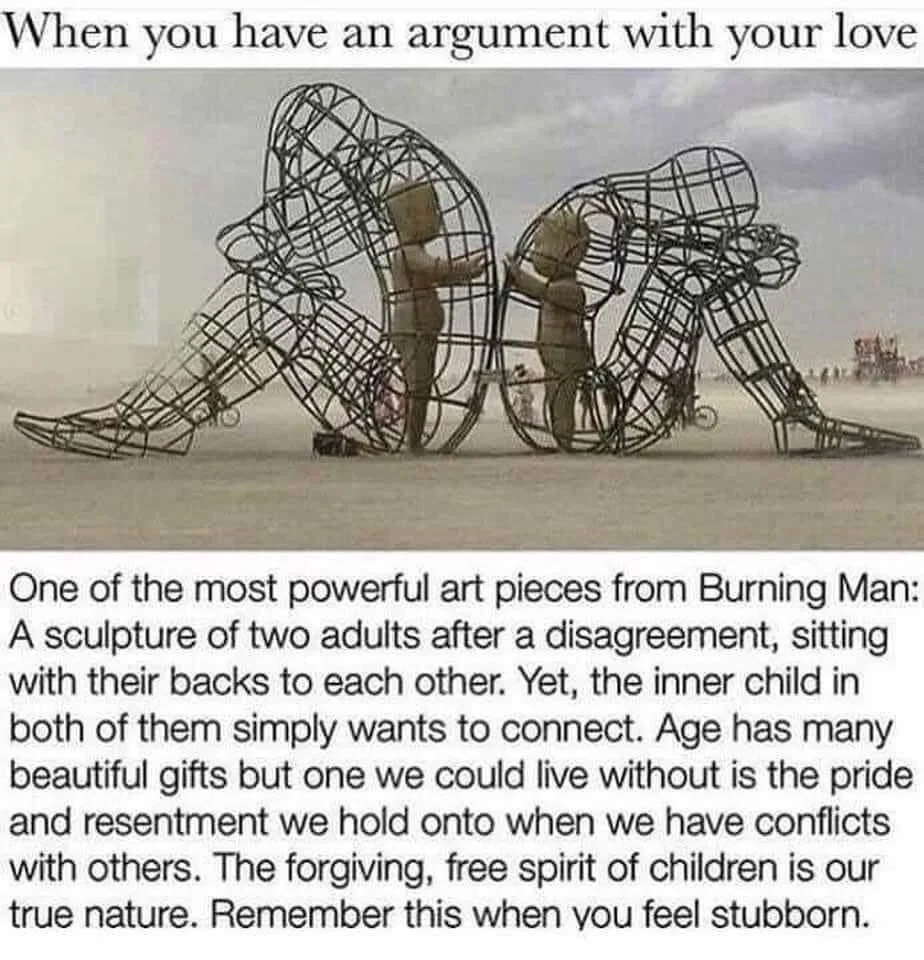
This image stopped me scrolling.
Two adults sitting back to back.
Hurt.
Frustrated.
Disconnected.
Yet inside them, their younger selves are reaching for one another.
Wanting connection.
Wanting comfort.
Wanting to know they’re still loved.
As a therapist, I look at this image and think, “This is what so many arguments are really about.”
Because most disagreements aren’t actually about the dishes, the text message, being late, the forgotten birthday card, the money, the holiday, or whose turn it was.
They’re about something much deeper.
“Do I matter to you?”
“Am I important?”
“Do you see me?”
“Am I safe with you?”
“Will you still love me if I’m upset?”
Most people don’t walk into an argument consciously thinking those things.
Instead, we get angry.
Defensive.
Critical.
Silent.
We withdraw.
We slam doors.
We say things we don’t mean.
Or worse, we say nothing at all.
And underneath it sits that vulnerable part of us desperately trying to be heard.
Trauma Doesn’t Stay In Childhood
One of the biggest misconceptions I hear is that we should simply “grow up” and leave childhood behind.
If only it were that simple.
The reality is that our nervous systems remember.
If you grew up feeling unheard, criticism may hit harder.
If you grew up walking on eggshells, conflict may feel terrifying.
If love was inconsistent, distance may feel unbearable.
If your needs weren’t met, you may struggle to ask for them directly.
So when something happens in adulthood, it isn’t always just the adult part of us responding.
Sometimes it’s the ten-year-old.
The eight-year-old.
The frightened teenager.
The child who learned they weren’t enough.
And suddenly an argument about something seemingly small feels enormous.
Not because you’re dramatic.
Not because you’re broken.
But because your nervous system is responding to more than what is happening in the present moment.
We All Want To Be Chosen
I often work with couples who are exhausted.
Not because they don’t love each other.
But because they’ve become trapped in a cycle.
One person pursues.
The other withdraws.
One gets louder.
The other gets quieter.
One demands answers.
The other shuts down.
Both feel alone.
Neither feels understood.
And both are often standing there saying exactly the same thing underneath:
“Please choose me.”
“Please understand me.”
“Please don’t leave me emotionally.”
That’s why communication matters so much.
Not perfect communication.
Not textbook communication.
Human communication.
Learning to say:
“I’m hurt.”
Instead of:
“You never care.”
Learning to say:
“I need reassurance.”
Instead of:
“You don’t love me.”
Learning to say:
“I’m scared.”
Instead of:
“Fine. Whatever.”
Simple in theory.
Incredibly hard in practice.
Especially if nobody ever taught us how.
Pride Is Expensive
One thing this image captures beautifully is pride.
That stubborn place where neither person wants to move first.
Neither person wants to apologise.
Neither person wants to be vulnerable.
We’ve all been there.
I’ve been there.
Yet the irony is that most of the time, both people are hurting.
Both people want resolution.
Both people want connection.
And both are waiting for the other person to make the first move.
The longer that happens, the more resentment builds.
The more stories we create.
The more disconnected we become.
The Goal Isn’t To Win
This is something I talk about regularly in couples work.
The goal isn’t to win.
If someone wins and someone loses, the relationship loses.
The goal is understanding.
Curiosity.
Compassion.
Being willing to step into your partner’s shoes for a moment and see the world through their eyes.
Not agreeing with everything.
Not tolerating abuse.
Not abandoning your own needs.
But seeking understanding before defence.
Because most people soften when they feel understood.
Therapy Is Often About Helping The Adult Hold The Child
The inner child concept gets thrown around a lot online.
For me, it’s much simpler than people make it.
It’s about recognising that younger parts of us still exist.
The scared parts.
The lonely parts.
The ashamed parts.
The parts that learned survival strategies long before we had adult resources.
In therapy, we gently explore those parts.
We help them feel heard.
We learn where they came from.
And slowly, we stop expecting our partners, friends, children, parents or colleagues to heal wounds they didn’t create.
Instead, we learn how to care for ourselves differently.
How to communicate differently.
How to connect differently.
The Privilege Of Being Human
What I love most about this image isn’t the adults.
It’s the children.
Because despite everything, despite the hurt, despite the backs being turned, despite the silence…
The children are still reaching.
Still hopeful.
Still believing connection is possible.
And honestly?
I think there’s something beautiful about that.
Because healing isn’t about never arguing.
Relationships aren’t about never disagreeing.
It’s about finding your way back to each other afterwards.
Again.
And again.
And again.
Maybe that’s what healthy relationships really are.
Not perfection.
Just two imperfect people willing to turn around.
💛
If this resonates, whether in your relationship with a partner, friend, family member or even yourself, therapy can help you understand the patterns underneath the conflict and find new ways forward.
Stay safe, stay connected and take gentle care.
Louise x
Wildfire Counselling & Therapy
Tunbridge Wells & Online