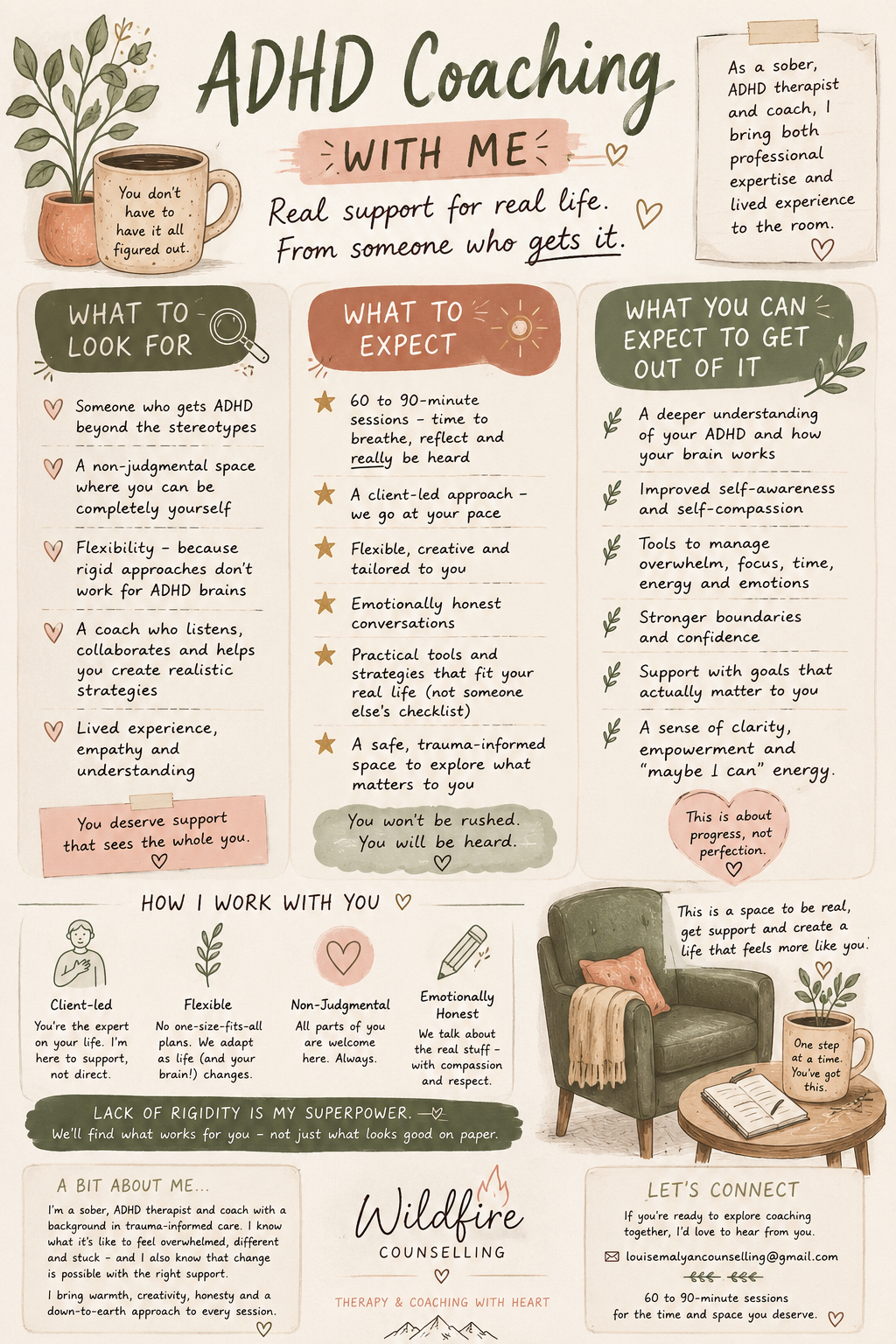
ADHD Coaching Isn’t Therapy… nevertheless, It Can Be Life Changing
I see posts regularly from people saying they were getting absolutely nothing out of ADHD coaching.
They felt directed.
Talked at.
Exhausted.
Like they were being told what to do rather than understood.
And honestly? It got me thinking.
Because ADHD support should never feel like another environment where you’re failing, masking, trying to “perform properly,” or squeezing yourself into someone else’s system.
That’s not how I work.
And it’s also why understanding the difference between ADHD coaching and therapy really matters.
So… what
is
ADHD coaching?
ADHD coaching is practical, supportive and future focused.
It’s about helping someone understand how their brain works and finding ways to make life feel more manageable, less overwhelming and more aligned with who they are.
That might include things like:
overwhelm and paralysis
Rejection Sensitivity understanding
procrastination
routines and structure
emotional regulation
motivation and dopamine seeking
work struggles
business support
burnout
studying and learning
communication
relationships
organisation
sensory needs
confidence and self esteem
people pleasing
time blindness
task initiation
accountability
And here’s the important bit…
Good ADHD coaching should never feel rigid.
Because ADHD brains aren’t rigid.
Therapy and coaching are not the same thing
Therapy often looks at the deeper emotional world.
Past experiences.
Trauma.
Attachment.
Shame.
Patterns.
Nervous system responses.
Wounding.
Identity.
Coaching is usually more action based and present focused.
“How do I move forward?”
“What works for me?”
“How do I stop drowning in life admin?”
“How do I actually DO the thing?”
The two can overlap beautifully, especially with neurodivergent people, because many ADHDers carry years of shame, criticism, rejection sensitivity and burnout alongside the practical struggles.
And that’s where my work is a bit different.
Why I work differently
I’m not someone who sits there with a clipboard rigidly directing your life.
I work relationally.
That means we build trust first.
Because honestly? Most ADHDers have spent years being misunderstood, corrected, criticised, rushed, dismissed or told they’re “too much.”
So why would I recreate that environment?
I work with clients, not on them.
Your goals matter.
Your feedback matters.
Your autonomy matters.
I regularly check in with clients to make sure sessions are actually helping and meeting their needs. If something isn’t working, we explore it together.
Because there is no one-size-fits-all ADHD support.
Some clients love structure and accountability.
Some need flexibility.
Some need space to process verbally.
Some need practical systems.
Some need both.
Some sessions we deep dive into one subject.
Others we explore 20 things at once because that’s how your brain is firing that day.
That’s ok.
ADHD support should feel human
I’m very down to earth.
You can swear.
Fidget.
Move around.
Sit cross legged.
Bring snacks.
Take notes.
Forget what you were saying halfway through.
Message yourself reminders & Whats App me reminders of things you want to bring.
Need things repeated.
Need visual aids.
Need body doubling.
Need processing time.
You are not “doing therapy wrong.”
You are not “bad at coaching.”
Your brain simply works differently.
And when support is neuro-affirming rather than rigid, things can shift massively.
What to expect working with me
Sessions are collaborative.
No judgement.
No pretending.
No pressure to perform.
We explore what works for you.
That may involve:
practical strategies
nervous system regulation
routines that actually suit ADHD brains
sensory support
emotional overwhelm
accountability
creative exploration
body doubling
breaking tasks down
understanding dopamine
exploring shame and self worth
helping you work with your brain rather than constantly against it
Sometimes clients need practical support.
Sometimes emotional support.
Sometimes both.
And that’s ok too.
A huge thing I encourage? Find someone you feel drawn to.
Not every coach is for every client.
And that matters.
If you don’t feel safe, understood or comfortable, it’s hard to do meaningful work.
Go with your gut.
Talk to a few people.
Ask questions.
See how they respond.
Notice how you feel.
You deserve support that feels human.
Questions to ask when looking for an ADHD coach
Do they understand neurodivergence beyond stereotypes?
Can sessions be flexible?
Do they work collaboratively?
Are they trauma informed?
Do they understand nervous systems and shame?
Will they adapt to your learning and communication style?
Do you actually feel comfortable with them?
Can you be yourself around them?
Because the relationship matters.
Massively.
The right support can change everything
ADHD coaching isn’t about “fixing” you.
You are not broken.
It’s about understanding yourself properly, often for the very first time, and building a life around how your brain genuinely works.
That can be life changing.
I’ve seen people go from feeling lazy, chaotic, incapable and ashamed… to understanding they were never failing.
They simply needed support that fit.
And honestly?
That’s the kind of work I absolutely love.
❤️🩹
If this resonates and you’d like to explore ADHD coaching or therapy with me, feel free to get in touch for a free no obligation intro chat.
Stay safe, stay connected and take gentle care,
Louise x
📍 Tunbridge Wells & online
🌿 Wildfire Counselling & Therapy
📧 louisemalyancounselling@gmail.com
🔗 www.wildfirecounsellingtherapy.co.uk