Perimenopause, Dog Walks, and Lemon Fanta
Perimenopause, Dog Walks, and Lemon Fanta
Today has been strange.
I was up super early. Started work at 6:45am with a genuine spring in my step. Productive. Focused. On it. I even surprised myself.
We had a beautiful Wellbeing Wednesday session and Lydia from Riding the Trauma Train joined us. It was thoughtful, grounded, powerful. I felt connected. Purposeful.
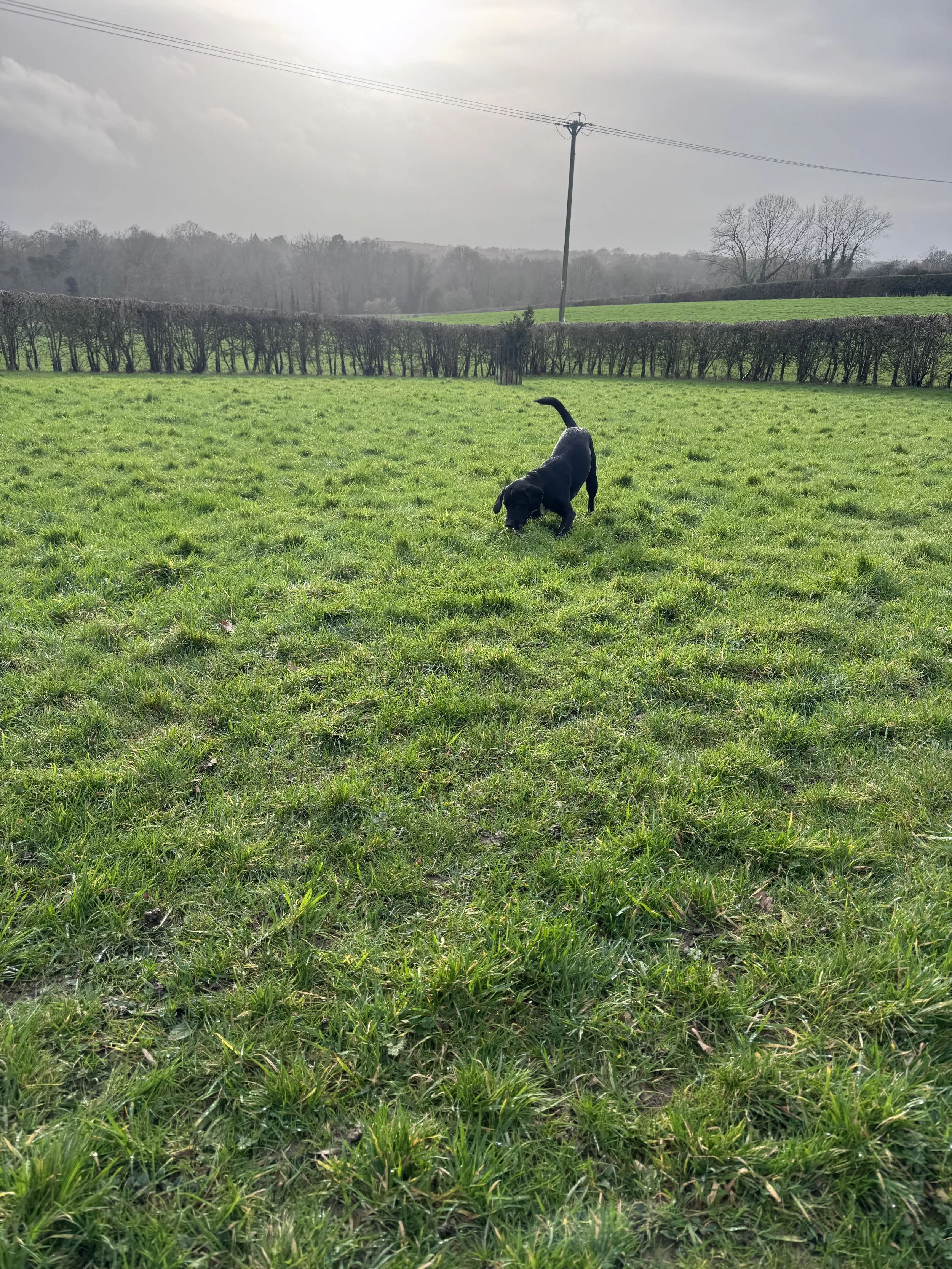
Then I took Arthur for a walk.
And somewhere between the mud and the trees, it hit me.
The emotional weight of perimenopause.
I talk a lot about effort in life. The invisible effort. The kind people don’t see. Perimenopause feels like that, extra effort layered on top of ordinary life. I’ve got diaries and alarms everywhere. Fans for night time. Cooling sheets. Creams. Vitamins. Patches for day. Patches for night. Itchy skin. Foggy memory. Forgetfulness that makes you question yourself. Add ADHD into that mix, where executive function already needs scaffolding, and it’s amplified.
But what I hadn’t fully clocked was the grief.
The loss.
Menopause isn’t just physical. It’s a transition. A closing. A shift you cannot reverse. I’m not wanting more babies. My children are grown. I love that they’re grown. And yet, walking along today, there was this wave of realisation: I will never be able to have babies again.
Not choosing not to.
Unable to.
There’s something primal about that. Something beyond logic. My brain knows I’m okay with it. My body seems to be having a separate meeting without me.
Then the empty nest thoughts crept in. All I haven’t done. All I missed. Questions about identity. Am I even a woman anymore? Writing that feels dramatic. Slightly unhinged even. But those were some of the thoughts moving through me.
And then the guilt.
Thinking about women who desperately wanted children and couldn’t. Feeling their imagined pain and then feeling ashamed that I was emotional at all. All of this in a 45-minute dog walk.
I came home, made a drink, and for a moment felt ridiculous. How can you go from capable professional woman at 6:45am to existential hormonal spiral by lunchtime?
But here’s what I know, both personally and professionally: emotions move. They surge. They crest. They settle.
I chatted it out. I doodled. I moved my body. I put music on, a bit of Madonna for good measure, cracked open a can of lemon Fanta and within half an hour it was like the storm had passed.
That doesn’t mean it wasn’t real.
It was intense beyond words at the time.
This is a whole new era for me. One that will need navigation, learning, support, and probably more fans and moisturiser than I ever anticipated. I’m fortunate to have incredible women around me who’ve walked this road already. The empathy I received today was powerful. They just knew. No long explanations required. That kind of quiet understanding is gold.
If you’re experiencing this, the fog, the grief, the irrational thoughts, the identity wobble, I see you.
It’s real.
And if today taught me anything, it’s this: you can go from grounded to overwhelmed and back again in the space of a dog walk. That doesn’t make you weak. It makes you human. It makes you hormonal. It makes you in transition.
Sometimes growth looks like therapy rooms and training courses.
Sometimes it looks like lemon Fanta and Madonna in your kitchen, reclaiming yourself one song at a time.
This era might be different. But different doesn’t mean diminished.
Stay safe, stay connected and take gentle care,
Louise x
Why I’m Leaving the BACP (and Why That Actually Serves My Clients)
This hasn’t been a knee-jerk decision. It’s been a slow, thoughtful, slightly uncomfortable one. The kind you sit with, chew over, run the numbers on, and then finally say: this no longer makes sense.
We’re often taught, especially during training, almost conditioned, that as counsellors we have to be with the BACP. That it’s the gold standard. That without it, we’re somehow less legitimate. But here’s the truth that doesn’t get said loudly enough:
The BACP is not a governing body.
It’s a membership organisation.
A members’ club.
I’ve completed my CPCAB Level 2, 3 and 4. I have a counselling degree. I’ve invested in numerous additional qualifications and ongoing CPD. I continue to train, learn, reflect, and develop because I take my work, and my client….seriously. None of that disappears because I choose not to renew one particular membership.
What has become very clear is the cost. Financially, emotionally, and ethically.
When I actually sat down and worked it out, I’ve paid the BACP far more than I’ve ever gained from them. Over £300 a year, every year. And in return? I don’t receive referrals from them. I don’t feel represented. I don’t feel consulted. And increasingly, I don’t feel aligned.
That £300 doesn’t come from nowhere. It comes from a small business run by a self-employed therapist in a brutal economic climate. It impacts my expenditure. And I’d far rather use that money to offer another concession place, fund more CPD, or buy creative interventions that directly benefit the people I work with.
Because here’s the thing: my practice is full.
I’m continuously booked.
My referrals come from word of mouth, recommendations, and real human connection.
That tells me something important is already working.
What really sealed this decision, though, was values.
The recent lipstick campaign felt completely disconnected from the realities of mental health. Spending members’ money on a campaign telling women over 50 to “put lipstick on and it will be okay” landed badly for me, professionally and personally. I work daily with people who have spent their entire lives masking, performing, shrinking, pretending they’re fine when they’re not. The idea that more masking is the message? That’s not something I can stand behind.
Mental health is not lipstick.
Healing is not presentation.
Authenticity matters.
Men’s mental health matters. LGBTQ+ mental health matters. Young peoples mental health matters. Children’s mental health matters. Everyone matters. And running a campaign in one shopping centre, in one part of the country, while claiming national representation doesn’t sit right with me.
There were other moments too. Seeing how unhelpful the organisation deals with situations and communication is sobering. Experiencing the framework as woolly at times, and the organisation as distant and hard to access, reinforced what I’d already been feeling.
In contrast, I’m also with the NCPS, and I prefer their ethos, inclusivity, and values. And they feel human. A helpful person answers the phone. There’s clarity. There’s accessibility. There’s alignment.
I’m also a fan of unions, and we have one in this profession, so I’ll be joining that too. Because collective support, clear advocacy, and practitioner protection matter.
Running a therapy business is hard. Being self-employed is hard. We constantly have to reassess, rethink, and make decisions that are sustainable, not just financially, but ethically and emotionally too.
Right now, this is the right decision for me.
And ultimately, it’s a decision that serves my clients.
Not every therapist will agree. That’s okay. Just like not every counsellor is right for every client. I believe deeply in the relationship, in integrity, and in practising in a way that feels honest and congruent.
This choice does exactly that.
And I’m at peace with it.
Stay safe, stay connected and take gentle care
Louise x
Mud, Learning, and Doing Things Differently
Today hasn’t stopped raining. Mud everywhere. Even when the sun pokes its head out, it’s still… mud, mud, mud. There’s definitely something about this time of year. The damp seeps into everything, shoes, jeans, mood, motivation. You can’t quite escape the wetness of the world, even when you try.
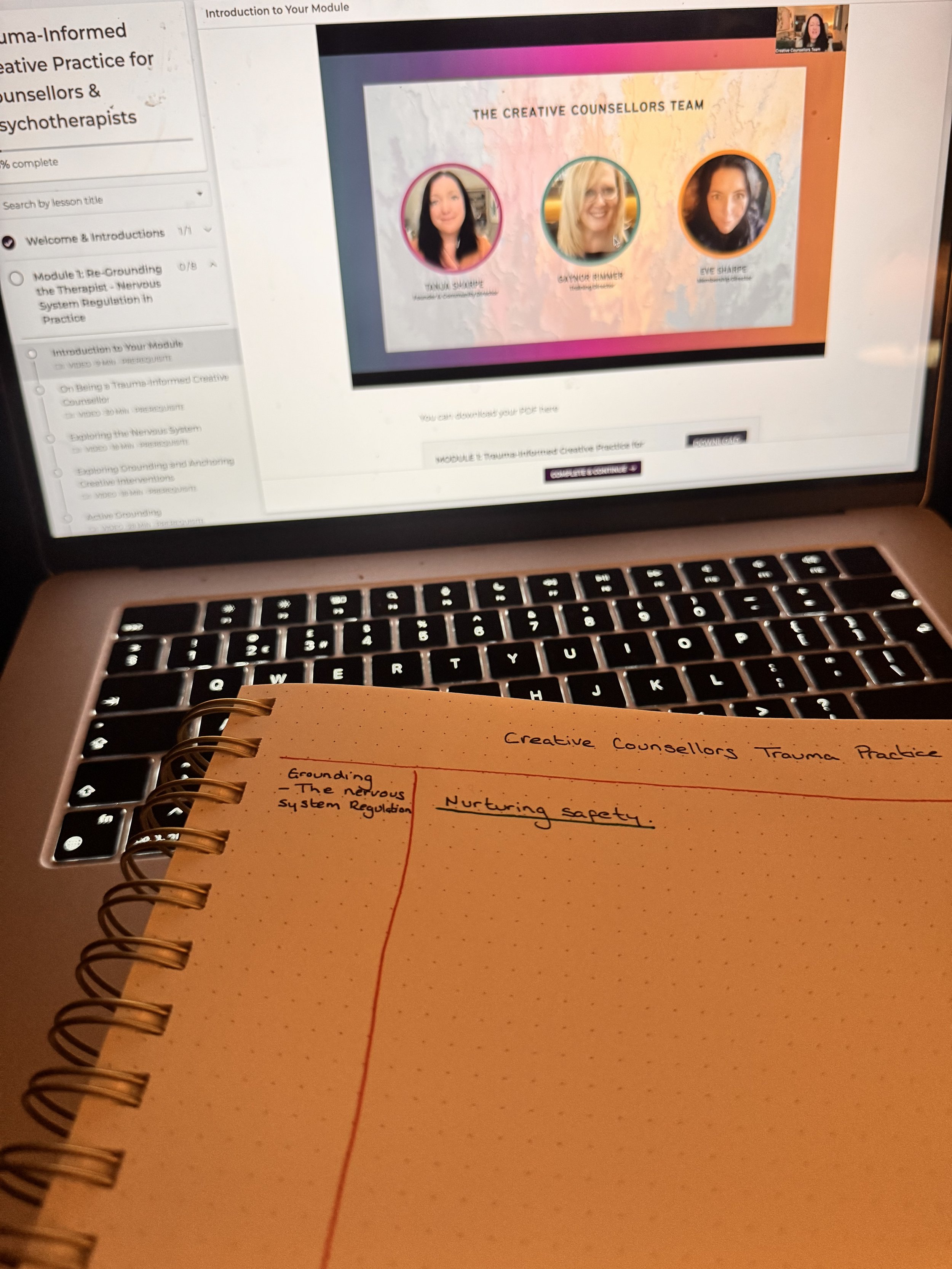
I’ve been busy today. Properly busy. I’m currently doing a few different courses because, as a therapist, learning never really stops. Basic qualifications get us started, but the real learning begins once you’re in the work. Right now I’m training in sex therapy, doing a creative trauma course, and adding more addiction training too.
Somewhere between the rain and the reading, I started thinking about learning itself, and how I learn.
I’m very visual. Always have been. My notes are colourful, mapped out, messy in a way that makes sense to my brain. For years, though, I thought I was “thick”. That I just couldn’t learn properly because textbooks didn’t stick. Turns out that wasn’t true at all. Nobody had ever shown me there were other ways to learn.
It was the support of an amazing tutor at university who gently pointed me towards a video instead of another chunk of text. And that was it. I was off. Something clicked. The problem was never my ability, it was the method.
That experience shapes everything about how I work now.
It’s why I don’t do therapy in a rigid, one-size-fits-all way. Because we aren’t all the same. We don’t think the same, feel the same, process the same, or heal the same. What works beautifully for one person might completely shut another down.
Therapy, for me, is about meeting people where they’re at, not where a model or framework says they should be. It’s about gently exploring what works for you. Words, images, metaphor, creativity, silence, movement, talking, not talking, all of it is valid. And we figure it out together, at your pace, with support.
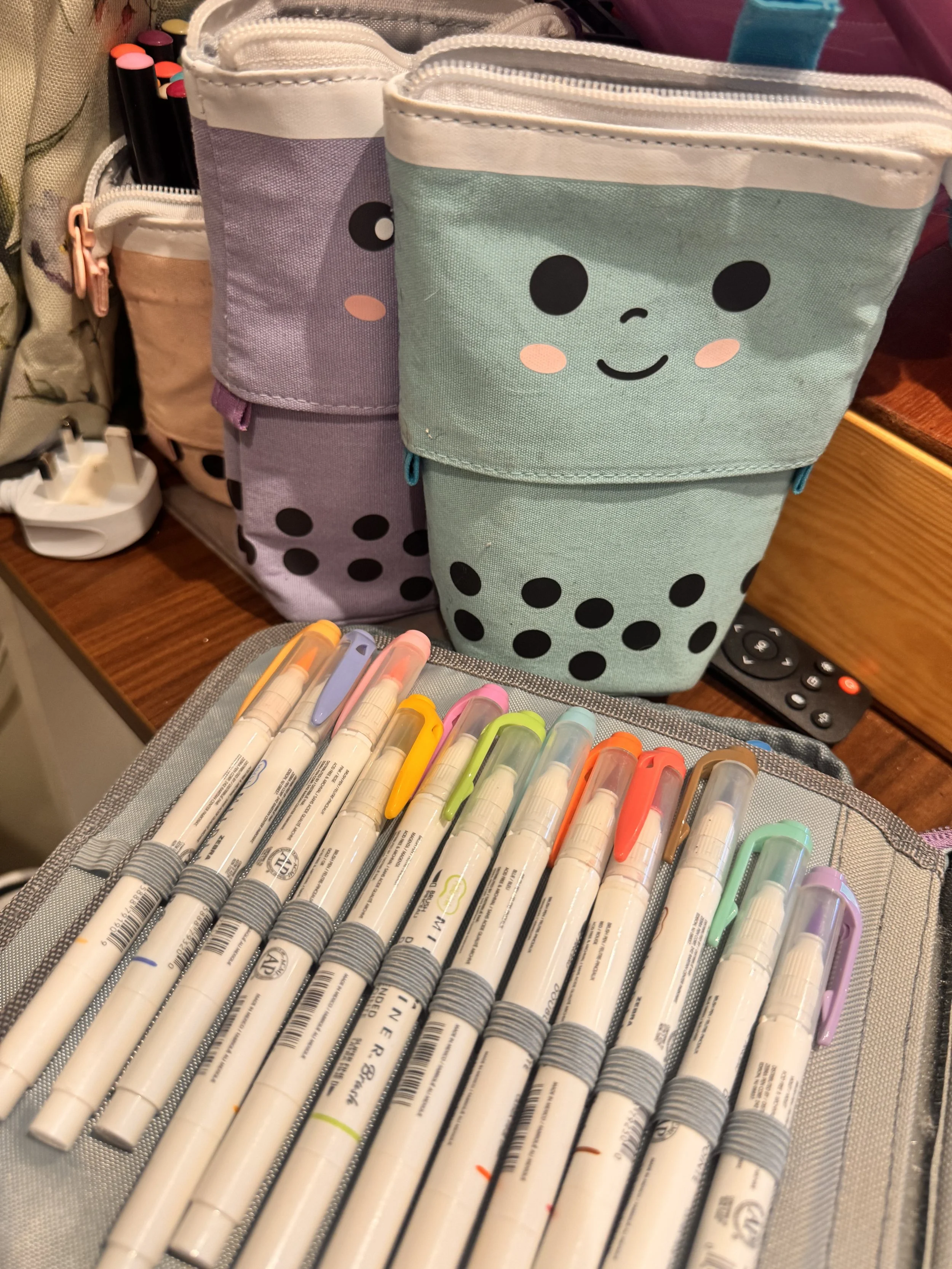
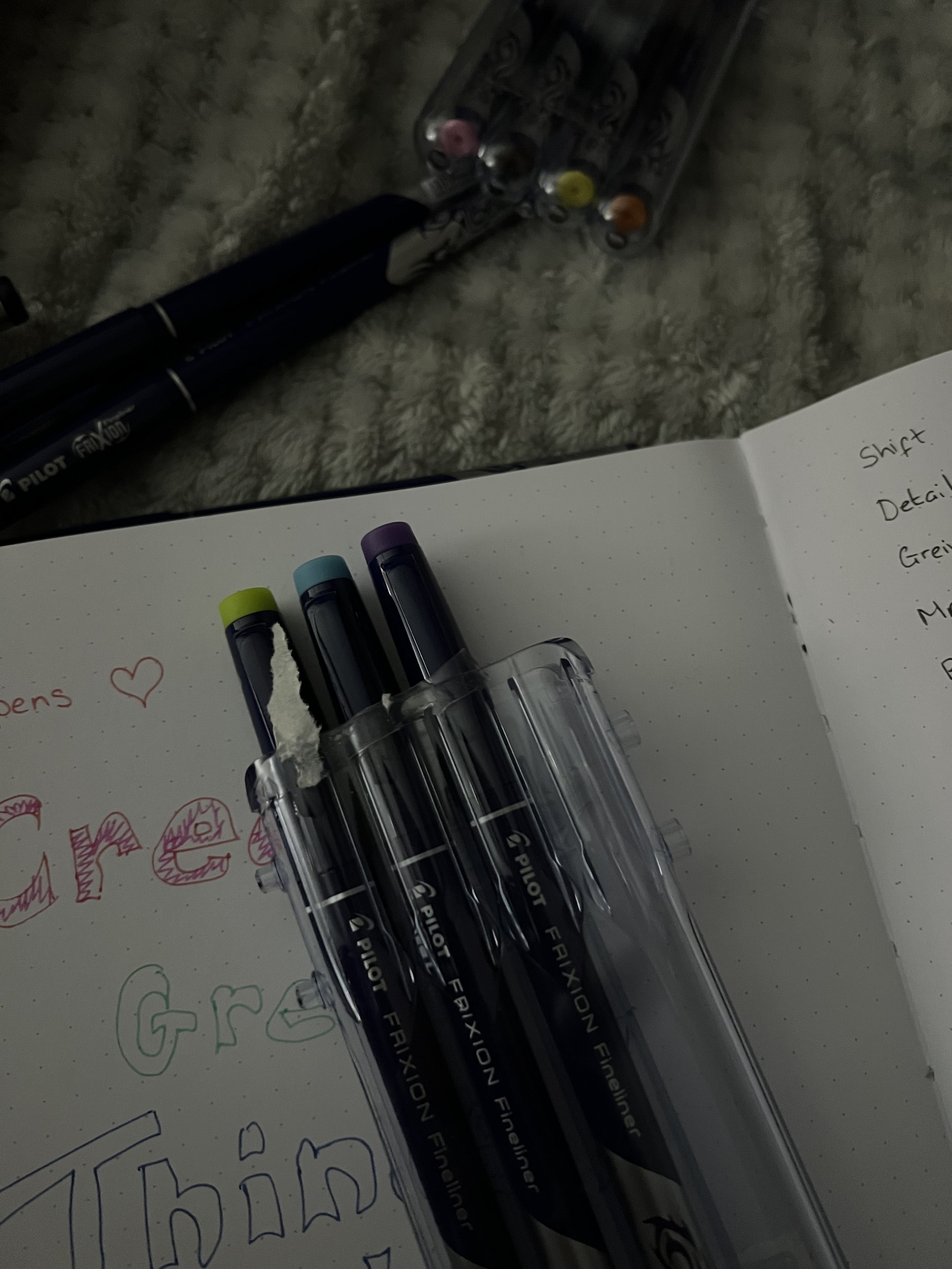
Since realising how I learn, how I learn matters. The right pens. The right notebooks. Dotted paper. Good quality pages. That might sound silly to some, but for many people it’s huge. Sensory experience is real. Scratchy paper and awful pens are a hard no. They shut my brain down before it’s even started.
It makes me wonder how many people are out there thinking they “can’t learn”, when actually they’ve just never been shown how they learn. How many people have struggled unnecessarily because no one offered patience, time, or alternatives.
Support matters.
Being seen matters.
Having someone say “let’s try this differently” matters.
So yes, I do all this learning for my work and for my clients, but here’s a little secret: I do it because I enjoy it. It feeds me. It supports my growth too. I genuinely love learning when it’s done in a way that works with my nervous system instead of against it.
And small win for today: I wrote three of the eight workshops. If you read yesterday’s blog, you’ll know why that matters… 😅
If learning differently is something that speaks to you, keep an eye on my shop page and socials. I’ll be running another note-taking and learning differently workshop soon, where I’ll share all my hints, tips, and ways of doing this without burning yourself out.
For now, stay safe, stay connected, and take gentle care.
Louise
Being Real, Sober, and Distractibly Me: A Night in the Life of Louise Malyan
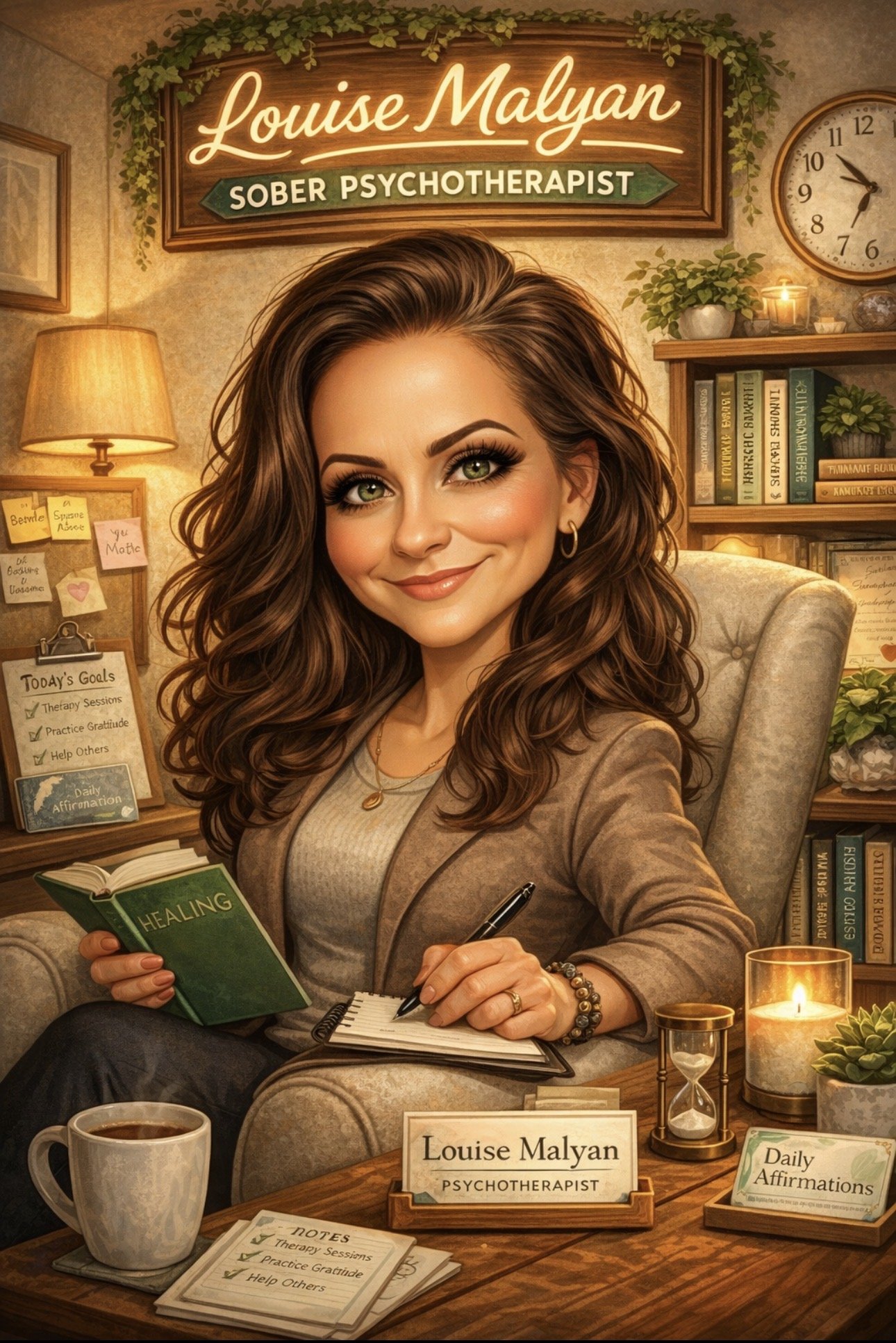
So here I am, award winning sober psychotherapist counsellor with ADHD, eight workshops to write for therapists, and… completely sidetracked by AI caricatures. Yep. Eight workshops. Not done. Instead, I’m drawing cats and people who look vaguely like me, giggling at my own creations, and thinking: this is fine.
Why am I telling you this? Because being real matters. A lot. I talk about lived experience in therapy for a reason. I’m not just someone who’s read the textbooks, though I’ve read plenty. I’m someone who’s been there, done that, survived it, and learned a little along the way. Sober, aware, messy at times, laughing at life even when it’s hard. And that matters in the room with a client. It matters with my supervisees. It matters in workshops.
See, ADHD isn’t a bug, it’s a feature. My brain jumps, skips, flits, and sometimes lands in a completely unrelated place. And that’s okay. In fact, it’s part of how I work. My sessions aren’t formulaic; they’re human. If a client is having a breakthrough through art, metaphor, fairy tale, sand tray, or just talking about their cat for 15 minutes, then that’s what we do. Because therapy isn’t about fitting someone into a mould. It’s about creating a space where the person in front of me can be seen, heard, and understood.
Not every counsellor is right for every client. And that’s fine too. My honesty, my humour, my creativity, my sober lens, my lived experience, that’s what I bring. That’s what makes me different. And yes, sometimes it means I get distracted making caricatures when I should be writing workshops. But it also means I notice when a client’s brain needs a little hop, skip, and jump to get to the heart of their story.
So here’s the takeaway: being real matters. Owning your quirks matters. Laughing at yourself matters. Crying when you are sad matters. And yes, ADHD brains and distractions? They can lead to joy, creativity, and connection. If my distractions make me smile, they also remind me that life, and therapy, isn’t meant to be perfectly linear. It’s meant to be lived, explored, and sometimes, illustrated in cartoon form.
If this resonates, you’re not on your own.
Pull up a chair.
I've got you.
Stay safe, stay connected and take gentle care.
Louise x
louisemalyancounselling@gmail.com
Listening to Anxiety Instead of Fighting It
Anxiety doesn’t usually arrive out of nowhere. It develops quietly, often after long periods of pushing, coping, managing, being “fine”, until one day your nervous system taps you on the shoulder and says: I can’t do this like this anymore.
Burnout and anxiety can completely floor you. Just because it isn’t visible doesn’t make it any less real. What I hear so often from people is this sense of confusion and self-doubt, why now? why can’t I cope like I used to?…….especially when they’ve been functioning, caring for others, working, surviving, for a very long time.
Something I’ve been sitting with myself recently is how anxiety often shows up as a protector emotion. It gets a bad reputation, but it usually isn’t trying to harm us. It’s trying to protect us from something underneath.
For me, starting a new course recently stirred up a lot of anxiety. Not because I didn’t want to do it, there was no lovic involved, this was purely involuntary and caught me by surprise. This was because when I slowed down and really listened, I realised what the anxiety was guarding was fear. Fear of getting it wrong. Fear of not knowing enough. Fear of not having worked with these people before. Fear of being exposed. And honestly… that makes complete sense. New experiences activate old survival wiring. Our brains like the familiar, even when the familiar is uncomfortable.
So instead of fighting the anxiety, I asked myself what it needed. I did the things we often forget are allowed as adults. I went for a walk. I listened to music. I talked it through with safe people. I did some research so I felt more prepared. I made sure I had the materials I needed to hand. And I gently reminded myself…..the way I would a child, directly to little me, that this is new, you’re allowed to not be perfect, you don’t have to get it all right first time.
That shift matters. Because anxiety often eases when it feels heard, not dismissed.
This is the work I do in therapy and supervision. We don’t shame anxiety or try to bulldoze it away. We get curious about what it’s protecting you from, and we build safety and capacity around that. We work with your nervous system, not against it. Especially if you’re burnt out, overwhelmed, or exhausted from holding it all together.
If you’re reading this and recognising yourself, diagnosis or not, you’re not weak, broken, or failing. Your system has been working very hard for a very long time.
What about you? Have you had moments like this, where anxiety showed up around something new or important? What helped, even a little?
Stay safe. Stay connected. Take gentle care.
Louise
If this resonates and you’d like to explore working with me in therapy or supervision, you’re very welcome to reach out for a free, no-obligation introductory chat. Finding the right person matters, that’s where healing begins.
LouiseMalyanCounselling@gmail.com
A Day of Learning (ADHD, Regulation, and Being Human)
Today has been a day of learning.
For me, and for Arthur, the therapy puppy.
ADHD often comes with chaos. A mouth that speaks before the brain has fully caught up. Reactions that happen fast, honest, and unfiltered. Before diagnosis, this can be especially painful, because being misunderstood and having assumptions made about you is something many of us have lived with our whole lives.
We’re often led to believe that we are the problem. That speaking plainly, directly, without fluff or bubble wrap, is wrong. So we try harder. We use more words. We over-explain. We desperately want to be understood.
Many people with ADHD are visual learners. Verbal instructions can feel like someone suddenly speaking Swahili, the words are there, but they don’t land. We’re trying to understand, truly we are.
Our energy can shift quickly. Full of ideas and momentum one moment, utterly exhausted and overwhelmed the next.
And then there’s rejection sensitive dysphoria (RSD).
RSD is an involuntary, intense emotional response to perceived rejection or criticism. It’s not a choice. It’s not dramatic. It’s a nervous system reaction that can feel physically painful.
A delayed reply. A change in tone. A raised eyebrow. Being told you’re selfish, inconsiderate, or not thinking of others.
When you already try so hard to understand people, include them, and do the right thing, those words can cut like a knife. All we want is to belong. To be included. To be loved.
Today, while trying to sort some admin, I spilled juice all down myself. I became so overwhelmed I couldn’t read the words on the page or make sense of what I was doing. I found myself sitting among a pile of washing, an overfilled bin bag that had burst open, and a crushing sense of uselessness.
Tears came. My chest hurt. And the familiar thought arrived: I’m 46, I should have this shit sorted by now.
So I did the only thing my nervous system could manage.
I put my coat and shoes on, grabbed my bag, and walked.
Tears streaming down my face, I walked and walked. Then I stopped.
Arthur was trotting along beside me on a loose lead, stopping to sniff, occasionally looking up to check in with me. A few weeks ago, he couldn’t do this. Not like this. And there we were, not perfect, but so much further along.
I’d been using visuals. Treats. Repetition. And slowly, it was landing.
I went home a little more grounded. The mess was still there. The puppy and Steve the cat got involved. I still couldn’t do the admin. But the washing got washed. The rubbish got sorted.
I stepped away. Then back.
Not to some miraculous breakthrough, but to the realisation that a walk and a bar of Galaxy chocolate had helped.
I’m not a dog. Treats don’t magically transform my brain.
What did happen was regulation. Enough calm returned for me to carry on a little.
For most of our lives, neurodivergent people have been forced into square holes we simply don’t fit into. Many turn to addiction to manage the relentless overwhelm. For some, it all becomes too much. Too many people never receive the care, understanding, and support they need to keep going. We are traumatised from insults, being shouted at and punishment.
Masking is exhausting. And it doesn’t always work. Sometimes that creates more confusion and pain that we should never have felt was an option to use to survive.
Our brains are different. Often running a hundred miles an hour faster than the world around us.
Tonight at training, when I had to ask twenty times, when I needed things shown rather than told, that was okay. My trainer offered that. I know how I learn. And I want to understand.
So if you struggle, diagnosis or not, please know this: it isn’t just a you thing. There are other ways. Find what works for you. Step away if you can to regroup. Ask yourself what has helped before.
And for anyone who treats others as if they’re stupid, lazy, or choosing this – it isn’t a choice. Empathy isn’t about fixing or correcting. It’s about showing the other person that you get it.
And Arthur?
Yes, he pulled the next time I took him out. Ran me in circles. Came home for snuggles. And the admin still wasn’t done.
But that’s okay.
Tomorrow is another day.
Stay safe, stay connected, take gentle care,
Louise x
This is how I work in therapy and supervision. We don’t try to force you into systems that don’t fit, or shame you for how your brain and nervous system respond. We slow things down, use what works for you, visuals, creativity, honesty, stepping back when it’s too much, and we work with regulation rather than against it. Whether you’re neurodivergent, traumatised, burnt out, or just exhausted from holding it all together, you don’t have to keep doing it alone. If any of this resonates and you’d like to explore working with me in therapy or supervision, you can email me at louisemalyancounselling@gmail.com. There is another way, and it doesn’t involve fixing who you are.
Making Time, Choosing What Matters
We often say we want to do things.
We say we want to rest more. Learn more. Move our bodies. Care for ourselves. Grow.
And then we say we don’t have time.
Yet when we pause and really look, time is often being spent elsewhere – scrolling, consuming, reacting. Screen time quietly stretches into hours. Things we believe are “fixed” or “can’t be moved” often aren’t quite as immovable as they feel.
Sometimes it isn’t about time at all.
It’s about permission.
Self-confidence plays a huge role here. When we don’t feel secure on the inside, saying no can feel risky. We worry about being left out. Rejected. Forgotten. We prioritise other people’s needs over our own because it feels safer.
When we feel more settled in ourselves, something shifts.
We know it’s okay to say no.
We know it’s okay to have boundaries.
We trust that relationships can survive disappointment.
So when last-minute plans land in our lap and clash with what we’ve already committed to, we don’t have to abandon ourselves. We can say, “I can’t do that today,” without fear that everything will fall apart.
That’s not selfish.
That’s modelling healthy boundaries.
I say this every Wednesday to counsellors and students: block the hour out. Shift appointments slightly. Make it work.
How can one hour a week for yourself, your growth, or your wellbeing feel so impossible?
The bemused looks often say it all.
But here’s the thing: when we grow, learn, and practise self-care, it’s not just for us. It benefits everyone around us. It prevents burnout. It makes us more present, more grounded, more ourselves.
This weekend, for the first time in a long time, I’m doing CPD purely for me. I’m doing a Cricut course. Spending time with my sewing machine. Going for a run. Walking the dog. Making progress on the sex, kink, and addiction courses I’m studying.
I almost went out instead.
But it didn’t work with the puppy, and honestly, I think that was the universe quietly stepping in.
Today is my niece’s birthday. She invited me out for dinner. I’m seeing her next week anyway, so I was honest and said I couldn’t do today.
She’s little, and she completely got it.
There was a flicker of disappointment, of course. That comes from love. But there was also acceptance, reassurance, and a calm certainty that we’d organise something another time. Off she went on her new bike, totally secure in the relationship.
A child understood boundaries better than many adults.
I wasn’t rejecting her.
I just couldn’t do today.
And in the way she received that, I had no doubt she loves me. She can hold disappointment without blame or shame, and then get back to enjoying her day.
Maybe we could all learn something there.
Listening. Hearing. Allowing the feeling. Not attacking or withdrawing. Just understanding.
Because of that, I could return to my original plans, plans I’d already shared and committed to. A weekend of learning at my own pace. Of rest. Of nourishment. Of doing what I need to do to stay well and avoid burnout.
There’s no fear of letting people down when you know your worth and your intentions.
So I’ve put what I need in my diary. With fresh air, some movement, a box of Christmas Heroes, spicy Doritos, and time to think.
And I know I’ll come out the other side richer, in knowledge, in rest, and in a quiet sense of achievement.
Sometimes making time isn’t about finding more hours.
It’s about choosing yourself in the ones you already have.
Stay safe, stay connected, take gentle care,
Louise x
Feelings, Empathy, and Why Being Understood Matters
One of the most painful experiences we can have is not being understood.
You can be surrounded by people, even people who care about you, and still feel deeply alone in how you feel. Often that’s not because anyone is deliberately unkind, but because feelings are invisible, and not everyone has learned how to really see them in others.
A lot of conflict, frustration, and hurt comes from a misunderstanding of what empathy actually is.
We often think empathy means feeling something about another person. But that isn’t quite it.
Take the cinema as an example. You’re watching a film and a character goes through something heartbreaking. You feel sad. You might cry. That feeling is real, but it isn’t empathy. The character doesn’t know you feel it. Nothing has been communicated or received.
What you’re experiencing there is your own emotional response. You might call it sympathy, or resonance, or compassion, but empathy requires something more.
Empathy is relational.
It’s when another person gets it.
When they understand, acknowledge, and reflect your inner experience in a way that lets you know you’re not alone with it.
That’s the space counsellors sit in.
In therapy, it’s not enough for a therapist to quietly feel something on your behalf. The other person needs to know they are understood. Empathy lives in that shared, communicated understanding.
This is also why things can feel so tricky in personal relationships, especially when one person has done a lot of inner work.
It can feel like a game you’ve both been playing for years, with unspoken rules. Then one day, you change. You learn new language. You see patterns. You understand emotions differently.
The problem is, the rules have only changed for you.
The other person is still playing the old game, because they haven’t done the same learning or reflection. Expecting them to suddenly respond with the same level of insight can feel frustrating on both sides.
We see this a lot with neurodivergence too.
For some people, for example, it can be genuinely confusing to understand how someone else feels something they don’t feel themselves. That doesn’t mean there’s no care, it often comes down to differences in what’s known as theory of mind: the ability to recognise that other people have thoughts, feelings, and experiences that are different from your own.
Add trauma into the mix, and things become even more complex.
Someone living in a constant state of fight or flight experiences the world very differently. Their nervous system is always scanning for danger. When others appear to be “getting on with life as normal”, it can feel invalidating, as though there’s an expectation to feel fine simply because nothing obvious is wrong.
But trauma isn’t visible.
Grief is another place where this shows up painfully.
I’ve felt this myself recently. When people haven’t lost someone they love, or don’t experience family bonds in the same way, they often can’t understand the depth or unpredictability of grief. How one moment you can be laughing, and the next you’re floored by a wave of sadness.
That doesn’t mean the feeling is wrong.
It just means it isn’t theirs.
And this is something really important to remember:
Feelings are involuntary.
We don’t choose them. We feel them.
When feelings get pushed down or ignored, anxiety often steps in. Anxiety isn’t the problem, it’s the protector. It tries to keep us safe from feelings we don’t feel able to experience.
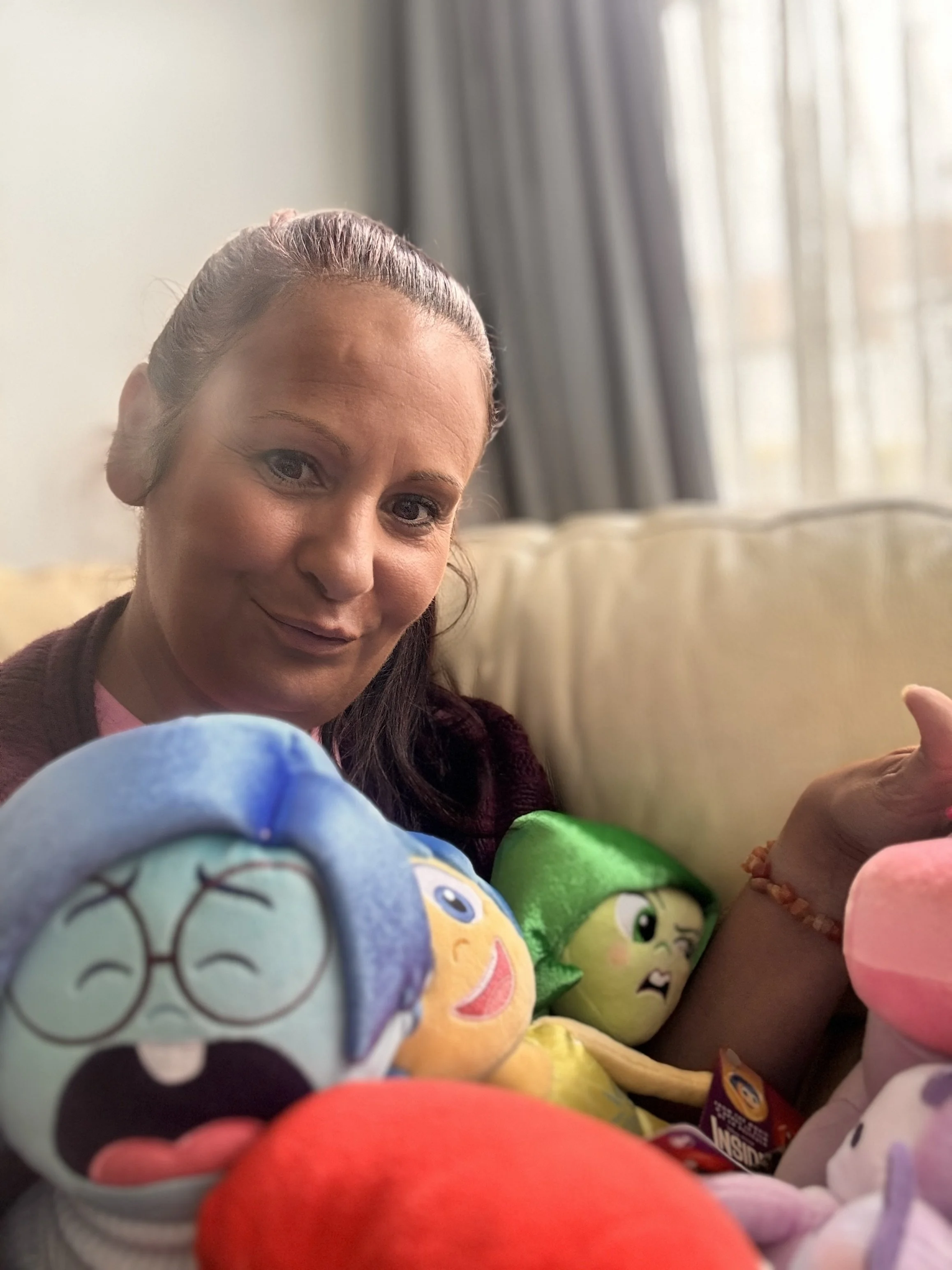
A brilliant way of understanding this is through Inside Out 2. When sadness and anger are pushed away, anxiety takes over to protect the system. Once those underlying feelings are allowed space, anxiety no longer has to work so hard.
When someone says, “I feel this way,” they’re not asking you to change how you feel.
They’re not blaming you.
They’re stating a fact about their inner world.
Many people who haven’t done much self-work struggle with this. They may not be ready. They may be scared. They may simply not have the tools yet. And that’s okay, it’s their journey.
Personally, I think therapy is something everyone would benefit from. I see the relief it brings when people finally get to put a weight down. I’ll admit my bias there!!
But even without therapy, there’s something we can all practise.
Respect.
I often think of a line from an interview with Pink that I love: we can all have different views, different beliefs, different opinions, just don’t be a dick.
That applies to feelings too.
It’s not okay to be abusive or nasty to someone because of how they feel. Someone else’s feeling doesn’t invalidate yours.
One of the simplest and most powerful shifts we can make is to speak from the I.
“I feel…” instead of “You always…” or “You make me…”.
That one change can completely alter the tone of a conversation, if the other person is willing to listen.
I was reminded of this recently while watching an interview where the live chat became heated. Someone spoke about coping through prayer and faith, and others responded with ridicule and anger.
That isn’t okay.
If prayer helps someone, it helps them.
If running helps someone, it helps them.
If climbing a mountain helps someone, it helps them.
Not everything works for everyone.
And not everyone has the same relationships, beliefs, nervous systems, or emotional worlds.
Empathy isn’t about agreeing.
It’s about recognising that another person’s inner experience is real, even when it’s different from your own.
That recognition alone can change everything.
Stay safe, stay connected, take gentle care,
Louise x
If any of this resonates, or you’re curious about exploring your feelings in a space where they can be understood rather than explained away, you’re very welcome to get in touch. I offer therapy, supervision and tailored workshops that is different to traditional talking therapy, relational, trauma-informed, down to earth and human at its core. You can email me at louisemalyancounselling@gmail.com to ask questions, find out more about working together, or arrange an initial free conversation.
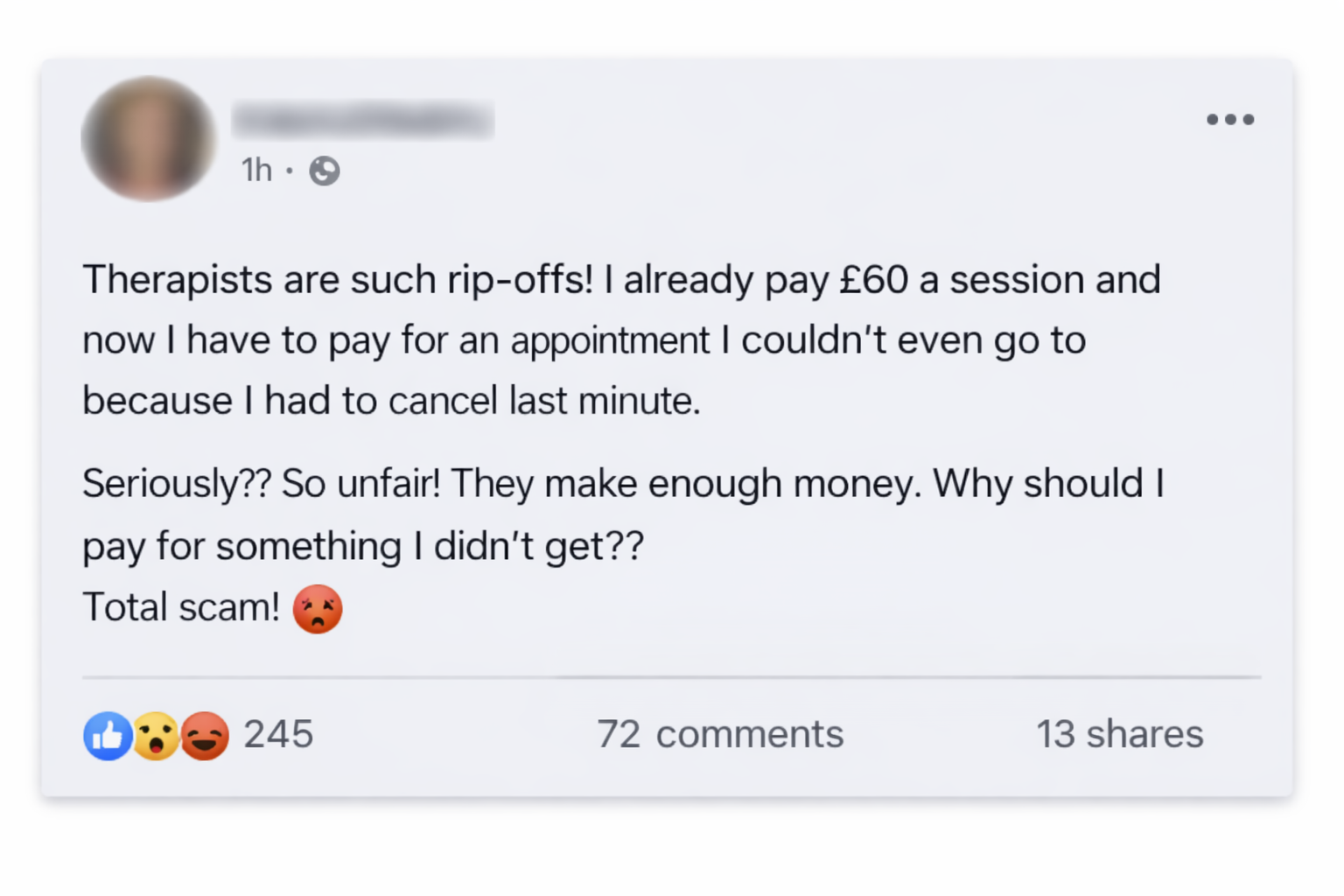
What Therapy Really Costs (And Why the Hour Myth Misses the Point)
There’s a common assumption about therapy that I hear again and again. Only today I read a post about the cost and laying into a therapist for their fee.
People often think therapists are earning an hourly fee, back-to-back, all day, every day. That we work 37.5 or 40 hours a week in paid sessions and go home comfortable, well-rested, and financially cushioned. To be quite frank, thats bull shit and simply not true!! If only! A girl can dream!!!
Jokes aside…..That isn’t how this work looks in reality.
So I want to gently pull back the curtain and explain what actually goes into therapy, not defensively, not to justify myself, but to educate and bring some reality to a picture that’s often wildly misunderstood.
When you pay for a therapy session, you are not paying for just that hour.
You are paying for the skills, the years of training, the ongoing learning, the infrastructure that keeps the work ethical and safe, and the unseen hours that support the moment you sit down and are held properly.
Before I ever see a client, I pay to exist professionally. I am registered with two professional membership bodies. I pay for insurance. I pay to be listed on three directories, not for vanity, (i rarely even get referrals from them, its all word of mouth) but so that if someone searches my name, they can see that my training is legitimate, my practice is accountable, and I am who I say I am.
I attend my own therapy and supervision as a non-negotiable ethical requirement. I have 90 minutes of clinical supervision twice a month, alongside weekly peer supervision. This is where client work is reflected on, safeguarded, and held responsibly. Supervision is paid for, and rightly so.
Alongside that, I read and train every single week as standard. Often, a client’s presentation means I will do additional, specific learning to make sure I’m working in the most informed and appropriate way for them. That learning costs both time and money.
Books, resources, creative materials, and therapeutic tools don’t magically appear. I’ve built a library and a studio of resources over years, and I am constantly adding to it so I can work flexibly, creatively, and safely with whatever a client brings.
Then there are the business realities.
I pay business rates. I pay for my website. I pay for the cost of holding sessions. I wash blankets daily and keep a constant fresh supply. I provide hot and cold drinks as standard. I pay the ICO. I pay an accountant. I keep up with regulatory changes, ethical updates, and best practice.
From every pound I earn, around 30p is immediately put aside for tax. That money is not mine. It also doesn’t cover holidays or sickness.
As a self‑employed therapist, if I don’t work, I don’t get paid, but all of the above still needs paying. Rent, bills, insurance, supervision, memberships, and life costs don’t pause if I’m ill.
This is why I also have to put money aside in case I’m unwell. There is no sick pay. No paid holiday. No pension contributions made for me. In previous employed roles, I had all of that. Self‑employment is not the financial freedom people often imagine.
Leaving unpaid slots isn’t a neutral choice. If I hold a session that isn’t paid for, I lose income while still covering all costs, which I just cannot afford to do, and someone else who may have needed that space may have been turned away. That’s why I ask for payment at booking, with a 24‑hour grace period. I believe that’s kind, fair, and realistic.
It’s also about accountability. People are far less likely to not attend when a session is paid for. If something is cancelled last minute, I use discretion and will move it within the same week if I genuinely can. If I can’t, I can’t, and that session remains paid for, with the next one needing payment as normal.
I work with complex trauma and very heavy material. That work matters deeply to me, but it also means I can only see a certain number of clients safely. Burnout isn’t an option, for me or for the people I work with.
I also choose to give back.
I heavily discount sessions for students, because that was once offered to me and I want to support. I offer discretionary free Rewind therapy for veterans. I provide concessions at significantly reduced rates for people who genuinely cannot afford extras in life. But if someone can afford things like holidays, takeaways, and non‑essential spending, therapy is charged at full price, because it is a priority, not a luxury add‑on. I trust that clients tell me the truth. I don’t ask for proof. I believe what they tell me and meet them where they are at. I only have so many sessions, so trust my clients. They know how I work, so if a situation changes, they can come to me & we can look at options. And yes, they do tell me when financial situations improve. Thats how valuable therapy is to them and how much they respect it. (I have amazing clients at whatever they pay.) I also will always endeavour to support clients who fall on difficult times. This work is so important. If I can, I will.
It cost me over £35,000 to do my basic initial training.
Four years of counselling training, and an additional two years where I studied and gained my counselling degree. Then in addition to my basic initial training I have completed numerous and robust Trauma trainings. Creative interventions. Group facilitation. Couples work. Clinical supervision. Inner child. Neurodivergence. Sexual violence. Children & young people. Personality disorders. Single‑session and solution‑focused qualifications. And the learning has never stopped, and never will.
I work hard. Bloody hard.
I am not coining it in.
Last year, I had unexpected time off in a year where I couldn’t afford a holiday. Then Christmas arrived, and I couldn’t work at capacity, its an enforced break!! I’m still doing my best to recover financially from that.
There are also the quieter costs: internet, phone, devices, secure systems, Zoom, software, all essential, all ongoing.
So when people ask about the cost of therapy, or assume therapists earn that hourly rate all day long, this is the fuller picture.
One session often carries hours of unseen work and continued learning behind it. Not because we’re forced to do it, but because we care. Because we’re passionate. Because we want to offer the very best we can to the person sitting in front of us.
I’ve won awards I barely talk about. That’s not what this is about. I dont need an award to tell me I am good at what I do. My work speaks for itself.
This work is about integrity. Presence. Skill. Safety. And offering something deeply considered and human.
Therapy is not expensive.
It is valuable.
And the people who do this work are not charging for an hour, they are holding a whole profession, a whole life of learning, and a whole lot of responsibility so you don’t have to do it alone.
This isn’t written to defend fees or justify worth.
It’s written to invite understanding, for clients, and for therapists alike.
For clients: your commitment to showing up, investing in yourself, and doing the work matters.
For therapists: the care, skill, restraint, boundaries, and invisible labour you bring every day matters.
Both sides of the room are doing something brave here.
Stay safe, stay connected, take gentle care,
Louise x
Disclaimer: The accompanying image is illustrative only. It is not taken from a specific client or identifiable individual. It reflects common themes seen across multiple public posts and is used solely for the purposes of education and discussion within this blog.
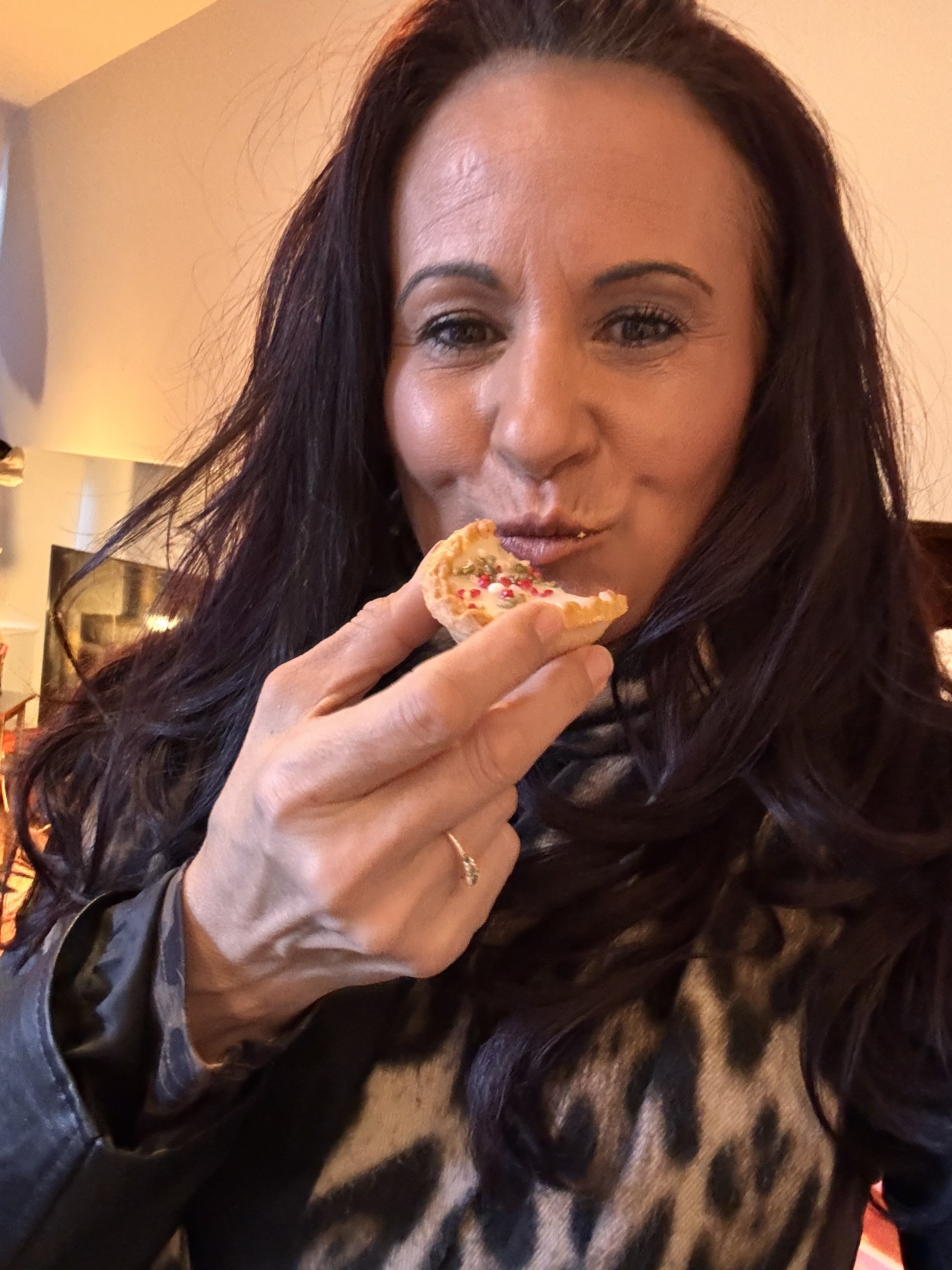
And the cake….a good old post Christmas yellow label!!!
The Side We Don’t See
We all have one.
The side we don’t show to the world.
As therapists and supervisors, we are often invited into that hidden place for others. We get the privilege of seeing the parts people carefully choose to share – the pain, the confusion, the shame, the hope. The pieces that rarely make it into everyday conversation.
Yet our own unseen side is often overlooked.
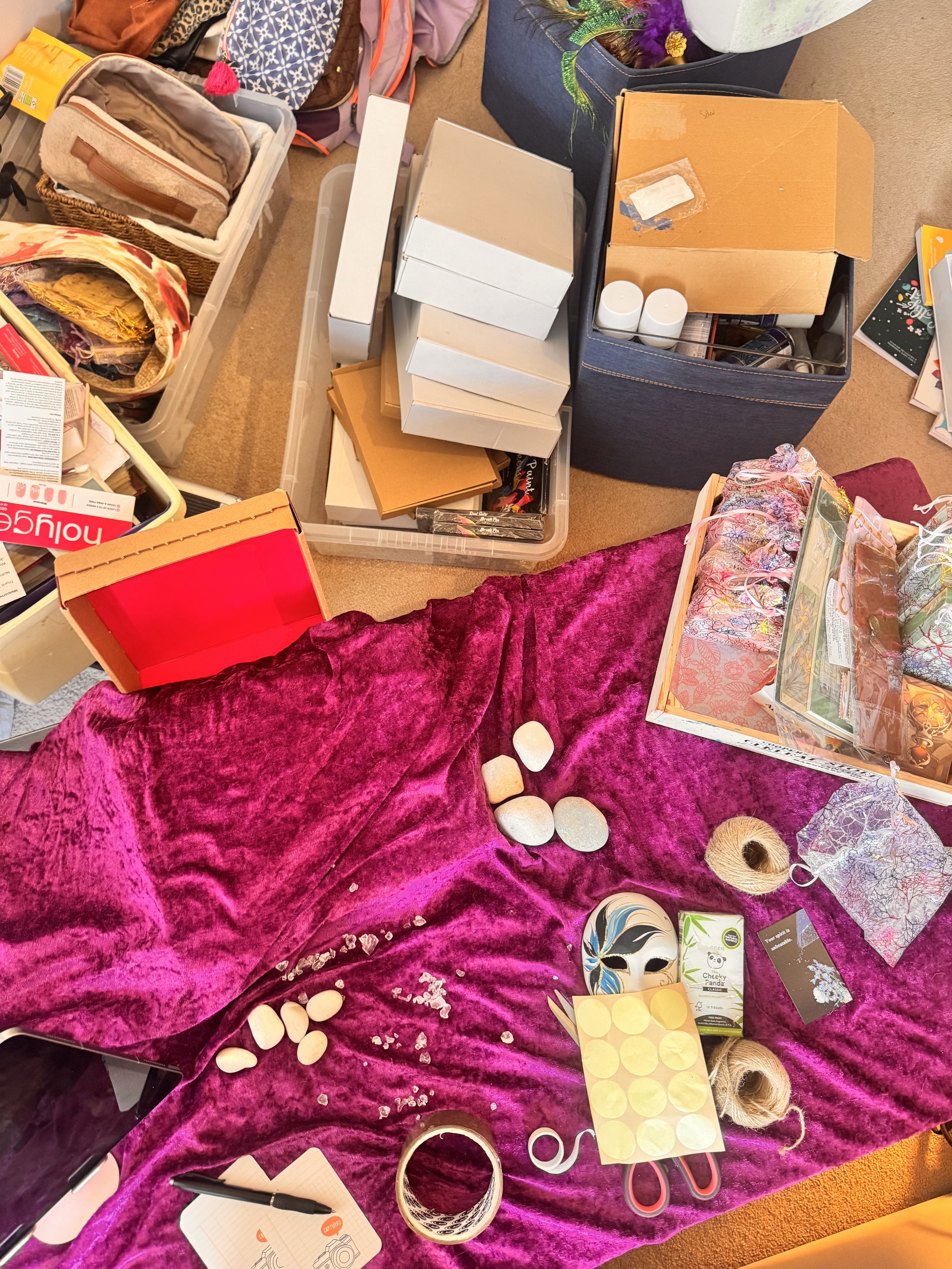
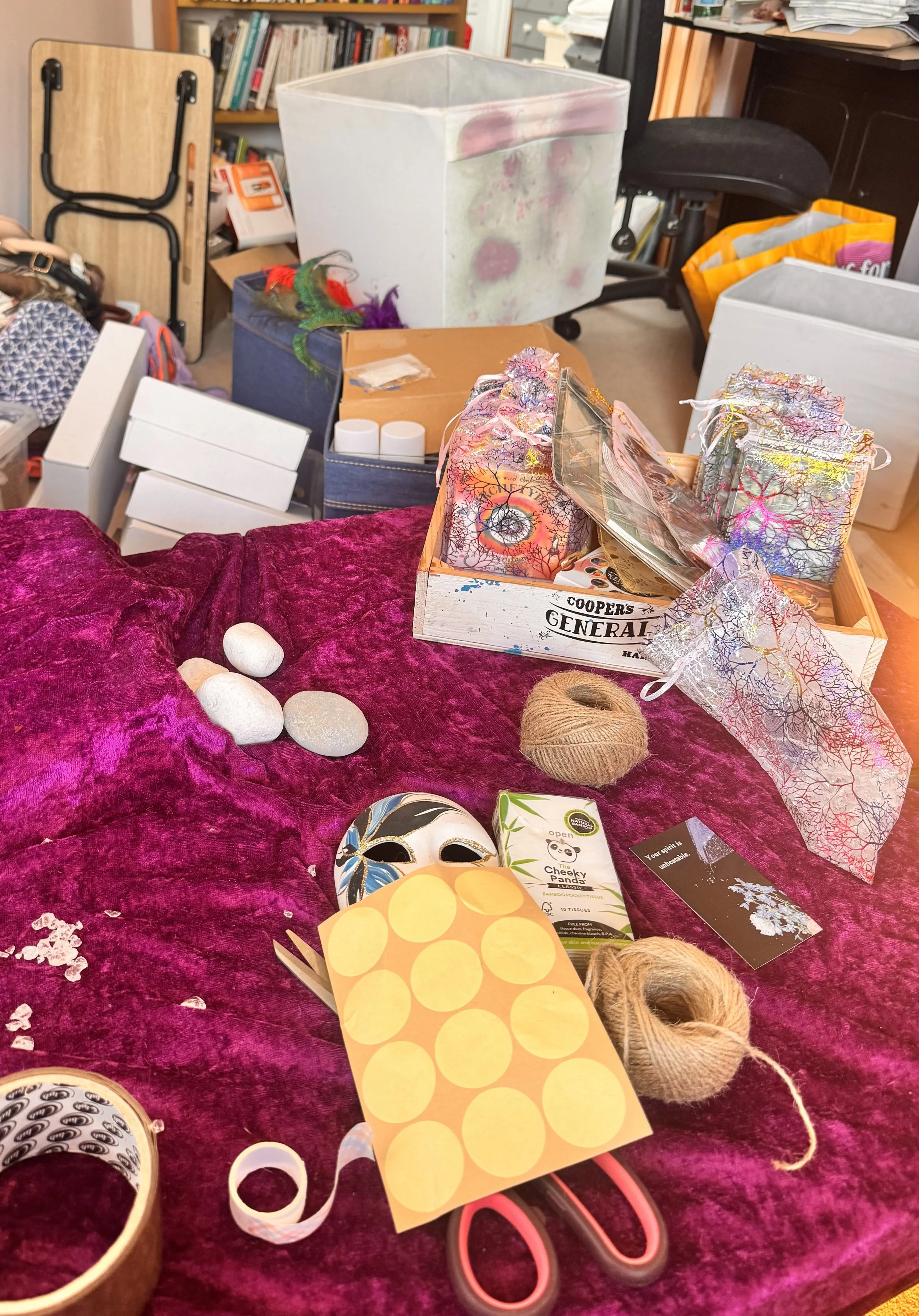
Today, while I was in my “workshop” a private space that very few people ever see, it struck me just how much of this work happens quietly, behind the scenes. Writing. Reading. Photographing. Packing. Making inventories. Creating. Reflecting. Learning. A space filled with books, craft supplies, half‑formed ideas, notes scribbled in margins, and a constant desire to do better for the people I work with.
From the outside, people often see one version of us: the therapist in the chair, the supervisor holding space, the facilitator running a workshop. That is the visible part. The polished part. The end result.
What they don’t usually see is everything that comes before and after.
They don’t see the hours spent reflecting on sessions, designing workshops, planning women’s circles, putting together creative kits, organising materials, creating and refining interventions, practising, researching, questioning, and trying again. They don’t see the time spent sitting with theory, cross‑checking ideas, wondering if something will truly land safely and usefully for the people who attend.
I spend countless hours in this space, surrounded by creativity, textbooks, admin, and a deep commitment to learning ,not because I have to, its because I care. Because I want what I offer to genuinely benefit others.
Therapy is not just a 50‑minute session.
A workshop is not just the hours people attend.
A 2.5‑hour workshop can easily carry 8–10 hours of preparation and reflection, especially when it’s being delivered for the first time. When you look at it that way, it often works out well below minimum wage.
A client session requires hours of research, training, reflection & supervision.
So why do it?
Because it’s a passion.
Because it changes lives.
Because it’s part of who I am.
This work doesn’t switch off when the session ends. It lives in the background of daily life, musing while washing up, reading research late at night, sourcing materials, trips to the post office, supervision, admin, ethical reflection. And that’s only the tip of the iceberg.
This isn’t just a job for many of us.
It’s woven into our lives.
So if you are a therapist, supervisor, facilitator, or practitioner who has been feeling unseen lately, I see you. I know how much you hold. How much you give. How much thought, care, and energy goes into work that others may only glimpse for an hour at a time.
You are important.
Your work matters.
And it is deeply valued.
Please remember to take time for yourself. To step back now and again and look at your work from another angle. To really notice how much you do, and how much of it often goes unacknowledged or taken for granted.
There is so much more to this work than what is visible.
And that unseen side deserves recognition too.
And perhaps this is an invitation.
For clients: to value the courage it takes to show up, to attend sessions, to sit with discomfort, to reflect on patterns, and to do the work of change alongside everything else life demands of you. Therapy isn’t something you simply attend, it’s something you actively participate in, often quietly, often bravely, often without applause. That matters.
For therapists, supervisors, and facilitators: to pause and really take in what you give. The emotional labour. The preparation. The thinking, creating, holding, repairing, and learning. The way you show up again and again, even when it’s hard. There is deep value in that, whether or not it is always named or recognised.
And for all of us: to take moments to feel proud. Proud of who you are. Proud of the work you do, in your profession, in your relationships, and in your inner world. Growth is not loud or showy most of the time. It’s steady. It’s intentional. It’s human.
The work you do, on yourself and for others, matters more than you may realise.
And none of this is ever just an hour.
Stay safe, stay connected, take gentle care,
Louise x
Access to Work ADHD Support: Real Help for Real Life (and Work)
If you have ADHD and you’re trying to work, grow a business, or simply keep your head above water, you might already know this truth:
You’re not lazy. You’re not broken. And you’re definitely not incapable.
But the way your brain works can make work feel exhausting, overwhelming, and at times impossible especially when you’re expected to function in systems that weren’t built with neurodivergent minds in mind.
This is where Access to Work can make a real difference.
What is Access to Work?
Access to Work is a UK government scheme that provides funding to support people with disabilities and neurodivergence, including ADHD, to stay in work, return to work, or set up and grow their own business.
For many people with ADHD, this funding can be used for a set number of sessions that include:
Practical, solution-focused ADHD support
Counselling support for emotional wellbeing
Help with overwhelm, burnout, confidence, and regulation
Support with work structures, routines, boundaries, and sustainability
This isn’t about fixing you.
It’s about supporting how you work.
Why ADHD Makes Work So Hard (Even When You’re Capable)
Many of the people I work with look like they’re coping just fine from the outside.
They’re running businesses.
Holding down jobs.
Showing up for clients, staff, or family.
Inside, it can feel very different.
Common struggles I hear every week include:
Constant overwhelm and mental clutter
Brilliant ideas but no clear way to start or finish
Time blindness and missed deadlines
Perfectionism mixed with procrastination
Emotional overwhelm, shame, and self-criticism
Difficulty prioritising or saying no
Burnout from masking and pushing through
Fear of failing or being “found out”
ADHD doesn’t just affect attention.
It affects emotions, self-worth, nervous system regulation, and confidence.
And when those aren’t supported, work becomes unsustainable.
How I Work (And Why It’s Different)
I offer Access to Work–funded support that combines practical, solution-focused work with counselling support, because ADHD is never just one or the other. I get when an idea or question comes in it can be hard to hold so whats app and email is available between sessions.
I’m ADHD myself. I run a successful business.
So I get it.
This means:
No judgement
No rigid systems that don’t fit real life
No “just try harder” nonsense
Instead, we work with your brain, not against it.
What We Can Work On Together
Our sessions are shaped around you and what’s getting in the way right now.
This might include:
Breaking work and business goals into realistic, achievable steps
Creating structures that actually stick
Managing overwhelm and emotional shutdown
Working with motivation (not shaming yourself for losing it)
Reducing burnout and people-pleasing
Building confidence and self-trust
Understanding your nervous system and stress responses
Letting go of years of shame around “not being enough”
The focus is always on practical change, emotional safety, and long-term sustainability, not quick fixes that fall apart.
Counselling
and
Practical Support…. Not Either/Or
Many people with ADHD have years of:
Being misunderstood
Being criticised or corrected
Feeling like they’re always behind
Pushing themselves past breaking point
That takes a toll.
Access to Work allows space for both:
Practical support for work and productivity
Counselling support for confidence, regulation, trauma, and self-worth
Because you don’t leave your emotions at the door when you sit down to work.
Who This Support Is For
This work is particularly helpful if you:
Have ADHD (diagnosed or self-identified)
Are employed, self-employed, or setting up a business
Feel overwhelmed, stuck, or burnt out
Want support that is flexible, human, and realistic
Have Access to Work funding approved (or are applying)
Sessions are available online, and I meet you where you are, literally and emotionally.
You Don’t Have to Keep Doing This Alone
ADHD can make you feel like the problem.
You’re not.
The problem is unsupported neurodivergence in systems that demand consistency, regulation, and performance without care.
Access to Work exists because support matters.
And the right support can change everything.
Get in Touch
If you’d like to explore working together using Access to Work funding, you’re very welcome to reach out.
📧 louisemalyancounselling@gmail.com
🌐 www.wildfirecounsellingtherapy.co.uk
I offer a free, no-obligation introductory chat, just to see if we’re the right fit.
Down to earth. Flexible. Real.
Support that works with you, not against you.
Take gentle care
Louise
Wildfire Counselling & Therapy
Rewind Therapy: When Trauma Feels Stuck and Keeps Replaying
Trauma has a way of refusing to stay in the past.
For many people, it shows up as flashbacks, intrusive images, nightmares, sudden fear responses, or a body that reacts before the mind has a chance to catch up. You might know you’re safe now, but your nervous system hasn’t got the message.
Rewind Therapy is a trauma-focused approach designed to help with exactly that.
It doesn’t require you to talk through every detail of what happened. It doesn’t involve reliving the trauma. Instead, it works gently with how the brain has stored the memory, helping it move from something that feels constantly present to something that feels safely in the past.
For many people, this can be genuinely life-changing.
The first Rewind session is longer, usually around 2 to 3 hours, because this work needs time, care and flexibility. We take breaks. You can move around. There are drinks, snacks, moments to pause, and space to breathe. This isn’t rushed work, and it’s never forced.
Rewind Therapy is usually completed in a single session, with a follow-up session to check in, support integration, and see how things have settled. While no therapy can ever be guaranteed to be 100% effective for everyone, Rewind Therapy has a strong evidence base and fantastic results for many people living with trauma.
It can help with:
PTSD and C-PTSD
single-incident trauma
ongoing or repeated trauma
recurring flashbacks or intrusive memories
“stuck” trauma that hasn’t shifted with other approaches
You don’t need to have seen me before to access Rewind Therapy. It can be a standalone piece of work, or something we integrate into ongoing therapy, whatever feels right for you.
Sessions are offered face-to-face or online, and we’ll always work at your pace, with your consent, and with safety at the centre.
Rewind Therapy isn’t about erasing what happened. It’s about helping your nervous system stand down, so the past stops crashing into the present, and life can start to feel lighter, calmer and more manageable again.
Take gentle care
Lou
Supervision That Sees the Whole You, Not Just the Work You Do
Supervision isn’t just about cases, contracts and ethics.
It’s about you, the person doing the work, carrying the stories, making the decisions and holding the responsibility.
I offer supervision that is down to earth, collaborative and human. A space where you don’t have to perform, impress or arrive with everything neatly packaged. You can bring the messy thoughts, the uncertainty, the emotional weight, and the questions you’re still forming.
I work creatively, but not in a “you must do this” kind of way. Creativity in supervision simply means adapting the space to suit how you think, learn and reflect best. Sometimes that looks like talking things through. Sometimes it’s noticing patterns, using metaphor, mapping things out, or exploring something differently when words feel stuck. It’s about finding what supports your growth, not forcing a model that doesn’t fit.
Supervision with me holds the whole picture:
your clients, your ethical responsibilities, your emotional wellbeing, and your business or practice. We can explore boundaries, confidence, imposter feelings, burnout, workload, and the realities of being self-employed or working within systems that don’t always support you.
I work with counsellors, therapists and other helping professionals who need a safe, discreet space to reflect and be supported. Confidentiality is essential. What you bring to supervision stays there.
Sessions are offered as 60 or 90 minutes, online, in person, or as a blend. I also offer ongoing support between sessions via calls, email and WhatsApp, because practice doesn’t only happen inside the hour.
If you’re curious about working together, I offer a free 20-minute introductory session. No pressure, no obligation, just a chance to see if I’m the right fit for you and your work.
Supervision should feel supportive, steadying and strengthening, not intimidating. And you don’t have to do this work alone.
Take gentle care
Louise
Creative Supervision: Not About Art, But About Doing Things Differently
Supervision is often described as a requirement, a tick box, or something you should do to stay ethical and safe in practice. And while all of that matters, supervision is also so much more than that.
At its heart, supervision is a space to pause. To step out of the intensity of client work and have somewhere to reflect, question, process and think out loud without judgement. It’s where ethical practice, learning and growth meet real human experience. And where you, as a practitioner, get to be supported too.
Creative supervision doesn’t mean you need to be “creative”, artistic or confident with materials. It’s not about making art or producing anything at all. Creativity in supervision is simply about doing things differently, in ways that suit you as an individual, your way of thinking, and the work you’re holding.
For some people, creativity looks like talking things through in a relaxed, conversational way. For others, it might involve using metaphor, noticing patterns, mapping things out, or exploring what’s stuck when words feel clumsy or circular. It can include reflecting on books, music, films, current affairs, or even moments from everyday life that connect to the work. Sometimes it means sitting with uncertainty rather than rushing to answers.
Creative supervision adapts to the person in the room. Because no two practitioners work the same way, think the same way, or need the same kind of support.
Supervision with me is a collaborative, supportive partnership. It’s not about being told what to do or feeling scrutinised. It’s about creating a safe, discreet space where you can bring the real stuff, the questions, the doubts, the ethical dilemmas, the emotional weight, and the ideas you’re still shaping.
I work with counsellors, therapists and other helping professionals, anyone whose role involves holding people, making complex decisions, and needing somewhere to reflect safely. Confidentiality and discretion are essential. What you bring to supervision stays there. This is not content for social media, and it’s not something that leaves the room.
Sessions are offered as 60 or 90 minutes, depending on what feels most supportive for your work. I offer supervision online, in person, or as a blend of both. I also provide ongoing support between sessions, with unlimited calls, emails and WhatsApp messages, because practice doesn’t only happen neatly inside a booked hour.
Alongside clinical reflection, I also support practice and business growth, not in a prescriptive, one-size-fits-all way, but in a way that helps you grow into the kind of work, practice or service you want to build. Something sustainable, ethical and aligned with who you are.
I offer a limited number of student concessions, because support early in practice matters.
Supervision isn’t about being perfect. It’s about being thoughtful, reflective and supported. Creative supervision simply makes room for you to arrive as you are, and to grow from there.
If you’d like to find out more, drop me a message or email and we can have an informal chat, no pressure, I am a true believer in trusting your gut,
Take gentle care
Louise
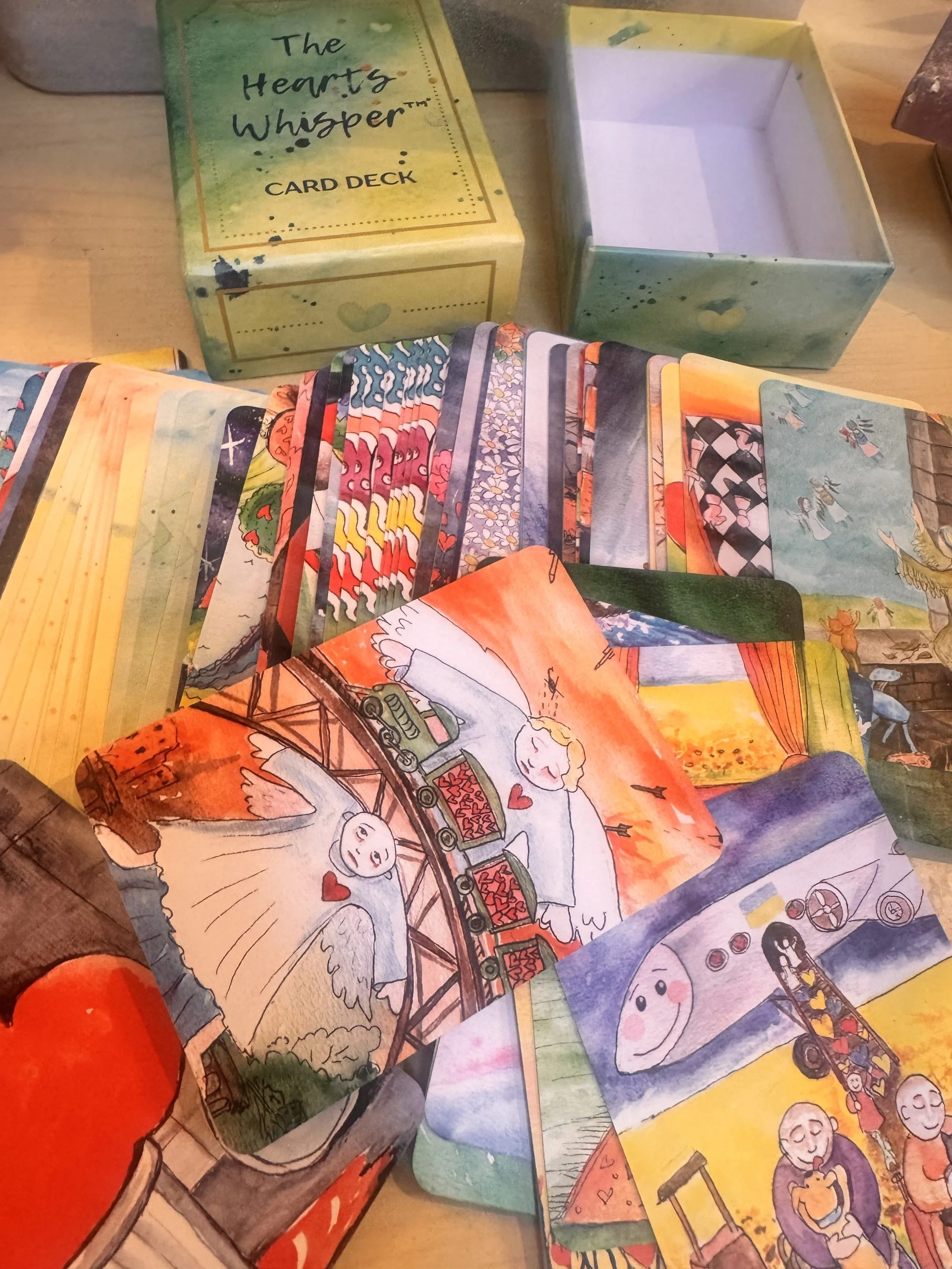
“Because sometimes, words are not enough”
When the Child Part Is Driving the Adult
There’s a side of a communication pattern that’s uncomfortable to look at, especially if you’re the one living inside it.
Not the people “on the receiving end”.
The person doing it.
The one who explodes.
The one who says things they don’t truly mean.
The one who feels justified in the moment, then confused, ashamed, or misunderstood afterwards.
The one who genuinely believes the world is against them.
This isn’t about being cruel.
It’s about being activated.
When early emotional needs weren’t met, not consistently, not safely, not reliably, the nervous system doesn’t grow out of that hunger. It carries it forward.
So as an adult, when something touches that original wound, the response doesn’t come from your adult self.
It comes from the child who was:
ignored
dismissed
blamed
abandoned emotionally or physically
expected to cope alone
loved conditionally
punished for having needs
That child doesn’t know how to ask.
They only know how to react.
So when a partner sets a boundary, disagrees, needs space, or simply can’t meet an emotional demand, it doesn’t feel like a normal adult interaction.
It feels like:
rejection
abandonment
betrayal
proof you don’t matter
And that’s when the defence kicks in.
The explosion
The words come out sharp.
Accusations fly.
Old scores get dragged in.
The aim isn’t connection, it’s relief.
Sometimes there’s a childlike urge to hurt the other person back.
Not because you want to destroy them, but because pain wants company.
Afterwards, many people say:
“I didn’t mean it.”
“That’s not how I really feel.”
“I was just angry.”
“They shouldn’t take it so seriously.”
However, impact doesn’t disappear just because intention wasn’t there.
And this is where relationships fracture.
Why boundaries feel unbearable
For someone with unmet childhood needs, boundaries don’t feel neutral.
They feel cruel.
A boundary sounds like:
“You’re on your own.”
“You don’t matter.”
“Your needs are too much.”
“You’re being left again.”
So instead of hearing:
“I need space”
“I can’t do that”
“This isn’t okay for me”
The nervous system hears:
“You are not loved.”
And the response is protection defensiveness, blame, control, withdrawal, or attack.
How this shows up with your children
This is where it gets even more tangled.
Many people with this wound over-identify with their children.
They protect fiercely.
They excuse behaviour.
They struggle to tolerate anyone else setting limits with their child.
Because when someone corrects the child, the adult’s own inner child feels criticised.
So it becomes:
“My child is being attacked”
“my parenting is being attacked”
“you are jealous of my child”
rather than
“My child is being guided.”
“My partner has needs”
“My partner is expressing themself”
Boundaries feel like rejection again.
Over time, this can lead to:
children who struggle with limits
children who control the emotional climate
children who learn to play adults against each other
fractures in blended families
resentment, exhaustion, and confusion in partners
Children who learn to manipulate
Children who struggle to maintain friendships & relationships
Children unable to take accountability- its always someone else’s fault
Children who cannot empathise
None of this comes from bad intentions.
It comes from unresolved pain driving the wheel.
The cost….
to you and to others
Living like this is exhausting.
Always scanning for threat.
Always defending.
Always feeling misunderstood.
Always waiting for people to finally prove they care “enough”.
Feeling that everyone else is the problem.
Trying to force a partner to change to meet your needs.
Relationships don’t feel safe, they feel high stakes.
And the tragic part?
No partner, friend, or child can ever meet the need your inner child is carrying.
That’s not because they’re failing.
It’s because that need belongs to the past.
What healing actually looks like
Healing doesn’t mean never being triggered.
It means recognising who is reacting.
It means learning to pause long enough to ask:
“How old does this part of me feel right now?”
It means separating:
adult needs from child wounds
boundaries from abandonment
disagreement from rejection
It means learning that:
Feeling hurt ≠ being harmed
Feeling disappointed ≠ being unloved
And most importantly:
It means taking responsibility without drowning in shame.
You can understand where your reactions come from and still own their impact.
Why therapy helps, when it’s done properly
This work isn’t about blame.
It’s about integration.
In therapy, we don’t silence the child part.
We listen, without letting it run the show.
We build:
emotional regulation
tolerance for boundaries
the ability to hold two perspectives at once
repair instead of rupture
safety inside, not demanded outside
So relationships stop feeling like battlegrounds.
And start feeling like places you can breathe.
If this felt uncomfortably familiar
That doesn’t make you bad.
It makes you human,
with old wounds still asking to be seen.
You are not broken.
But you might be bleeding into places that matter.
And that can change.
Relationships can heal & be beautiful.
We can feel loved, respected and committed.
We can communicate without triggers.
I work with this exact dynamic, gently, honestly, and without judgement.
I work with the person behind the reaction, not a diagnosis.
🌐 www.wildfirecounsellingtherapy.co.uk
📧 louisemalyancounselling@gmail.com
Free, no-obligation intro chat just to see if we’re the right fit.
Awareness is not an accusation.
It’s an invitation.
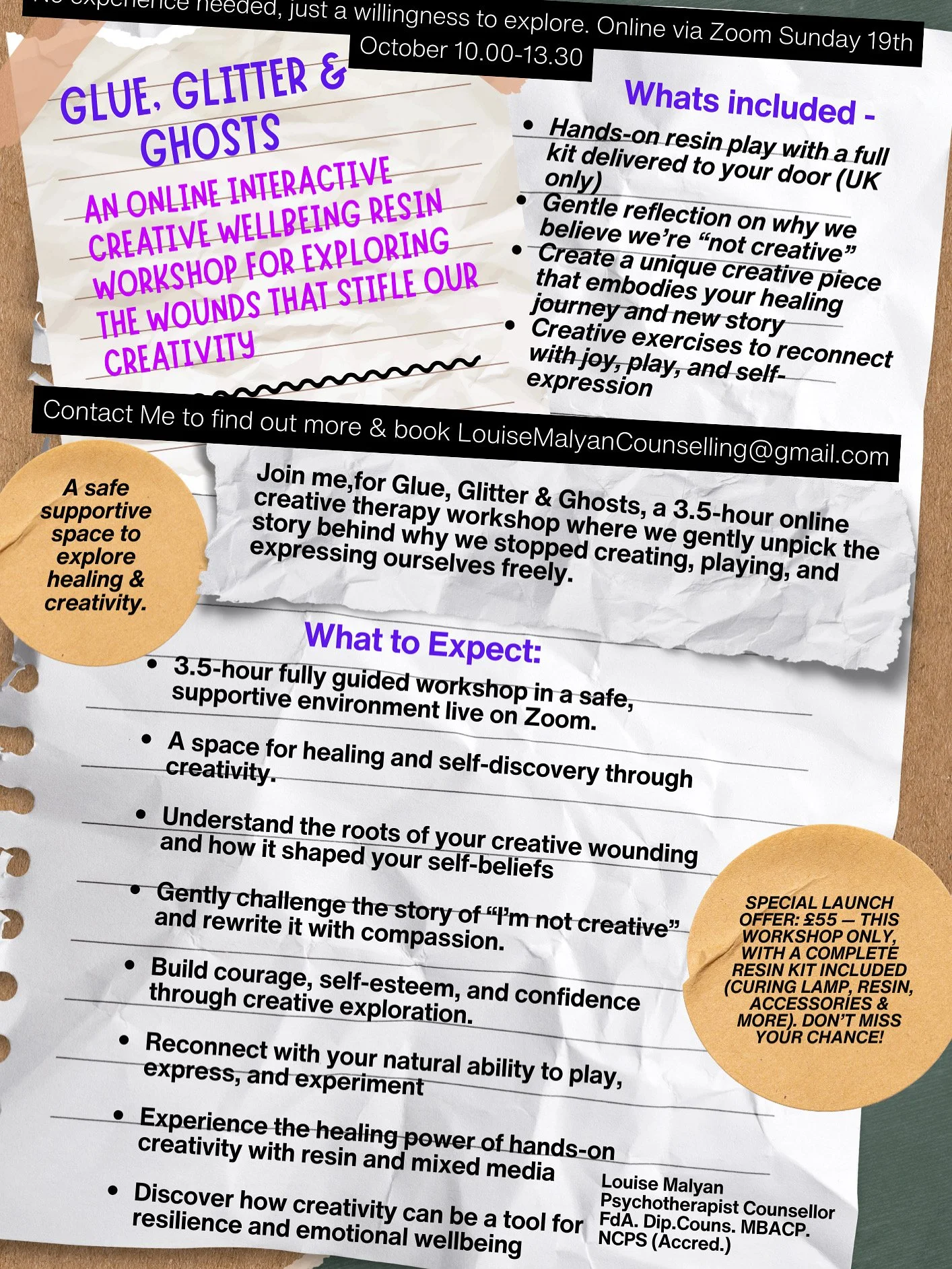
Glue, Glitter & Ghosts: Reclaiming Your Creativity
Have you ever told yourself you’re not creative? That play, experimenting, or making something just isn’t for you? I get it. I’ve been there myself, and so have so many of the people I work with.
But here’s the thing, creativity isn’t about art, skill, or producing something that looks perfect. Creativity is about expression. It’s about reconnecting with joy, curiosity, and the freedom to play. And sometimes, it’s about healing the wounds that stopped us from creating in the first place.
That’s why I created Glue, Glitter & Ghosts, a 3.5-hour online creative therapy workshop designed to gently explore the story behind why we stopped expressing ourselves. Together, we’ll trace the quiet, often unnoticed moments where our inner artist, storyteller, or maker was silenced.
What Happens in the Workshop
In a small, safe group online, we’ll:
Explore your creative wounding timeline, looking at the moments that shaped your self-beliefs about creativity
Engage in hands-on creative exercises, from resin play to writing prompts, storytelling, and more
Reflect and discuss, giving space to reframe old stories and reclaim your permission to play
Build confidence, resilience, and self-expression, reconnecting with joy in the process
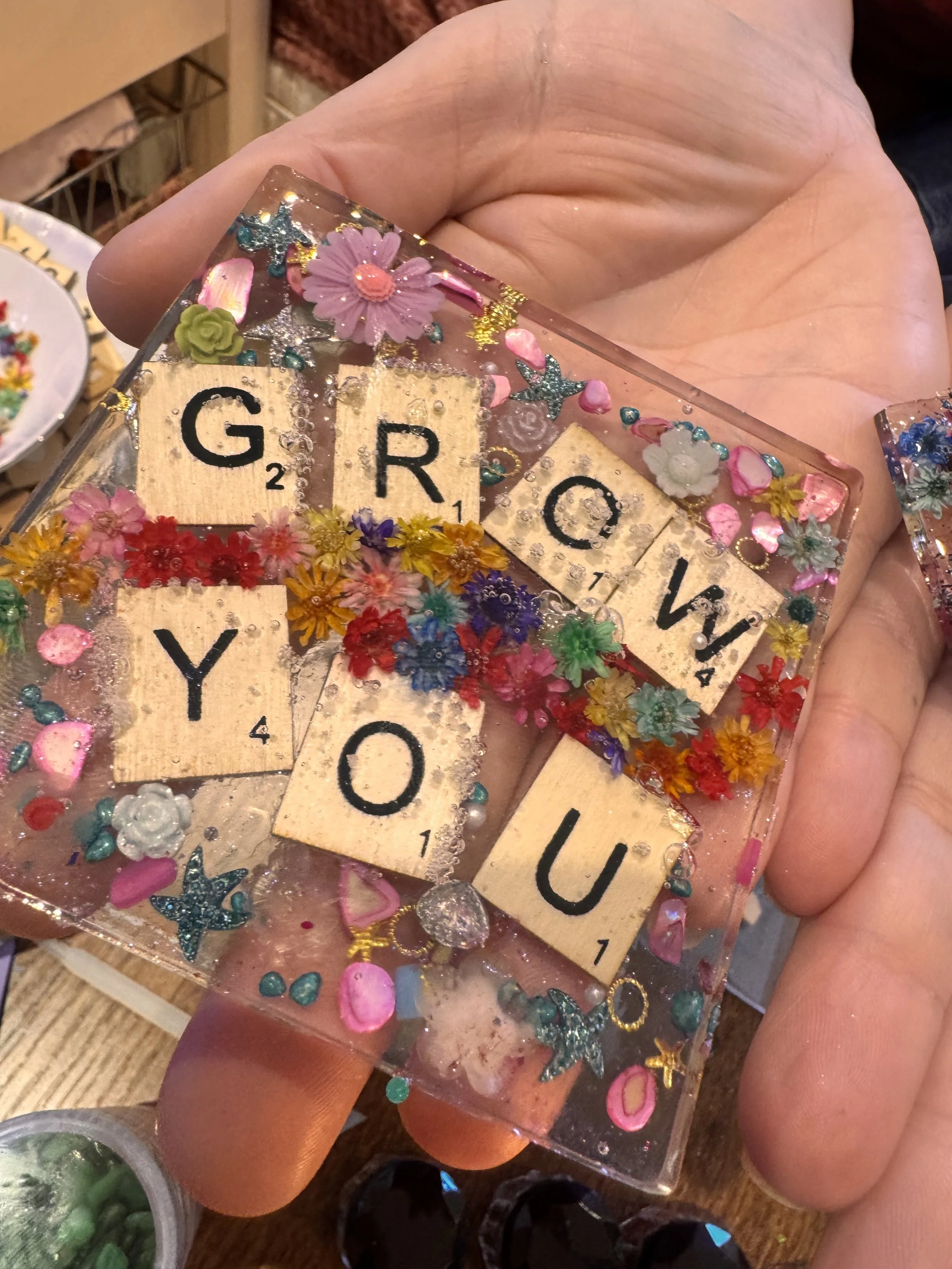
This isn’t about making “pretty things”….. although there’ll be plenty of opportunity for that if you want it. It’s about learning to give yourself permission to play, to experiment, and to heal the ghosts left by past experiences that made you feel you weren’t good enough.
My Own Experience
I’ve been exploring creativity more intentionally myself recently, especially during challenging times, and I’ve been blown away by how healing it can be. A simple set of pens, paper, and watercolours became a lifeline for me, a way to express what I couldn’t put into words. It reminded me that creativity isn’t a luxury; it’s essential for our wellbeing.
I’ve seen this play out with clients and colleagues too. When we engage with our own creativity, we grow. Confidence, self-awareness, and resilience all follow, and it ripples outwards, helping us connect more deeply with ourselves and with others.
What You’ll Take Away
By the end of the workshop, you’ll have:
Explored and begun to heal the blocks that silenced your creativity
Reclaimed permission to play, experiment, and express yourself freely
Created something meaningful, reflecting your own journey
A renewed sense of confidence and curiosity to carry forward into daily life
Practical Details
When: Sunday 19th October, 10am–1.30pm
Where: Online via Zoom
Cost: Intro price £55 including full resin kit delivered to your door (UK only) this price is an introductory one only!
Materials: Resin, curing lamp, moulds, pigments, tools, and extras to spark creativity
No experience is needed, just a willingness to explore. This is your chance to make a mess, make meaning, and maybe meet a part of yourself you haven’t seen in a while.
Spaces are small to keep the group supportive and safe, and applications are required to maintain emotional safety.
✨ Creativity isn’t about being perfect, it’s about reclaiming your story. Glue, Glitter & Ghosts is a space to do just that.
📧 To book your spot or ask questions: louisemalyancounselling@gmail.com
Stay safe, stay connected & take gentle care
Louise ❤️🩹


Creativity: More Than Art A Pathway to Healing
Over this past year, especially these past few weeks, I’ve been navigating a process that’s far from over. The grief I carry isn’t something I’ll ever “get over” I know it will live with me forever, in different ways, in ebbs and flows. Life also comes with challenges, and that’s part of the reason I felt compelled to write this.
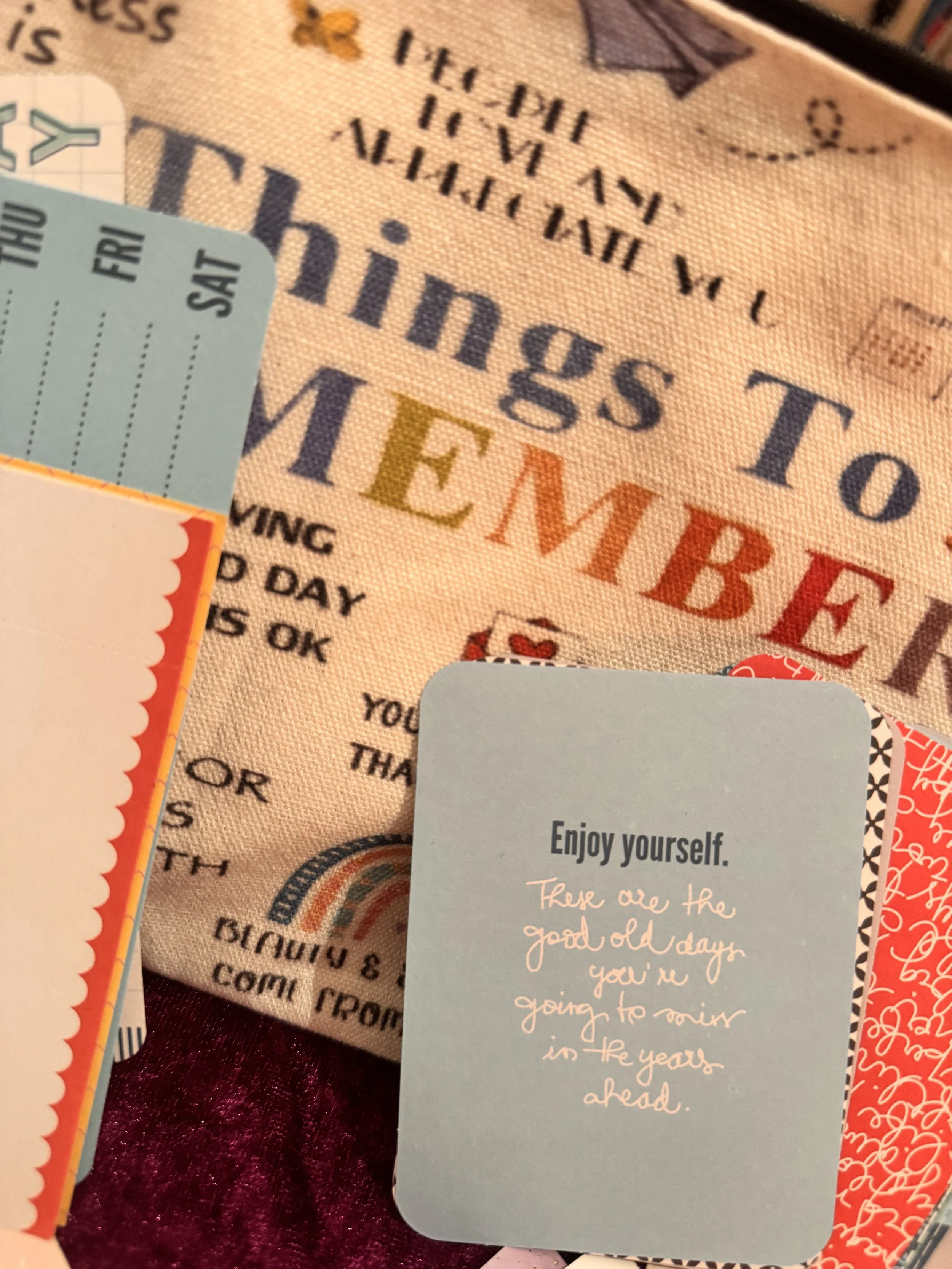
Throughout this time, I’ve been leaning into creativity, and it has been unexpectedly powerful. Even in the hardest moments, a simple bag I had with me at the hospital of pens, paper, watercolours, and a set of cards & other random bits became my lifeline. It helped me express emotions I couldn’t put into words, offered distraction when I needed it, and allowed me to create space for my own healing.
Creativity as a Healing Force
Unused creativity doesn’t just sit quietly inside us. As Brené Brown says, “Unused creativity is not benign. It metastasises. It turns into grief, rage, judgment, sorrow, shame.” I know this to be true from my own experience, when I ignore the urge to create, I feel it in my body, my mind, my spirit.
In therapy, creativity can offer something words alone cannot. A simple act of making, with colour, texture, or story, can bypass defences, touch something deeper, and give shape to feelings that have been buried for too long.
Letting Go of Misconceptions
For a long time, I thought creativity in therapy meant art therapy, and I shied away from it. I didn’t feel qualified. I worried I’d ask someone to “make art” and they’d resist. If you’d asked me five years ago, I’d have said, “That’s not for me.”
However, discovering creative therapy changed everything. My therapist gave me a gift that I will be forever grateful for. It has truly been life changing. Creativity is so much broader, it can be found in storytelling, metaphor, movement, collage, even arranging words on a page. It’s not about producing something beautiful or worthy of display. It’s about creating meaning, and that is life-changing.
Growing as a Therapist
When I gave myself permission to play and create, I noticed something shift inside me. My confidence grew. I found new ways to connect, to listen, to hold space. I learned to trust the process, not worry about the product.
Exploring my own creativity has helped me show up with more presence and openness in the therapy room. It’s allowed me to invite clients into different ways of exploring their inner worlds, ways that don’t rely solely on words, which can sometimes feel heavy, limiting, or unreachable.
And I’ve seen it ripple outwards. In peers and colleagues, when they embrace creativity, there’s curiosity, lightness, and willingness to explore that wasn’t there before. It’s powerful to witness, and it reinforces for me why creativity matters so much.
My Own Process
During this particularly challenging time, creativity has been my anchor. Clutching that bag of pens, paper, watercolours, and cards felt like holding a lifeline. It allowed me to distract, express, and process without the need for words.
Whether through writing workshops, experimenting with materials, or simply giving myself permission to play, creativity has opened space for my own healing. It reminded me that creativity isn’t a luxury, for me it’s essential.
Why I Want to Share It
Seeing the change in myself, in my clients, and even in family, friends, peers and colleagues has strengthened my belief in the power of creativity. It helps us heal, grow, and find confidence where we might have felt doubt. And that’s why I want to share it with others, because I’ve witnessed the difference it can make. Creativity reconnects us to parts of ourselves that have been silenced or shut down, and that reconnection is where healing begins.
An Invitation to Reconsider
So perhaps creativity isn’t something to fear or something only for “artists.” Maybe it’s something to reclaim, not as art, not as performance, but as a birthright, a natural part of being human.
What might happen if you allowed yourself to explore your creativity, not as an artist, but as a person seeking healing, joy, and self-discovery?
It’s a question I continue to sit with, and one I’d love for you to consider too.
Sometimes words alone are not enough.
Stay safe, stay connected & take gentle care
Louise


Rewind Therapy A Gentle, Transformative Approach to Trauma
Rewind Therapy
A Gentle, Transformative Approach to Trauma
Over the past few weeks, I’ve had quite a few enquiries after a Facebook post I put on my socials (ok, let’s be honest – more than a few!) about Rewind Therapy. What is it? How does it work? Why do I offer it?
If you're curious, you're not alone – so I thought I'd share a little more here, especially if you're exploring new ways to work through trauma that feel safe, grounded, and manageable.
What is Rewind Therapy?
Rewind Therapy is a trauma-focused approach I offer as part of my work with clients experiencing Trauma, PTSD and complex PTSD. And let me be really clear here, I only offer work I believe in. I’ve experienced Rewind Therapy both personally and professionally, and I’ve seen the shifts it can bring. Real, lasting changes.
What makes Rewind different is how gentle and non-invasive it is. You don’t have to talk through the details of what happened. You don’t have to relive or retell your trauma. For so many of the people I work with, that’s a massive relief.
How does it work?
Rewind gives you the opportunity to revisit traumatic memories in a safe, dissociative way. It gently allows your nervous system to process and let go of what’s been stuck, the flashbacks, the panic, the emotional overwhelm, the constant feeling of threat. The body stops sounding the alarm for something that’s no longer happening.
It’s not magic. But when that shift happens, it can feel pretty magical.
And just to clear this up, as I get asked it a lot, Rewind is not hypnosis, and it’s not hypnotherapy. It’s a standalone therapeutic approach grounded in neuroscience, delivered in a calm, compassionate way.
What does the research say?
If you like to know the evidence behind a therapy (and many of us do), the research into Rewind is really promising.
A 2023 study published in the International Journal of Environmental Research and Public Health looked at the impact of Rewind Therapy on veterans and emergency workers, people with long-standing, complex trauma. After just two to three sessions, the participants showed a clinically significant reduction in PTSD symptoms, and many of them still felt better six months later.
The study authors shared:
“The Rewind Technique was associated with a significant decrease in PTSD scores and demonstrated sustained symptom reduction over time.”
— Hooper & Murphy (2023)
It’s incredibly encouraging. You can read the full article here https://pmc.ncbi.nlm.nih.gov/articles/PMC11921860/
Finding the right therapist matters most
No matter how powerful a technique is, what matters most is that you feel safe and supported with the person you’re working with.
I know what it’s like to feel like your story is too much. To worry that therapy might make it worse. To feel like talking just opens up old wounds. That’s why I offer something different.
I don’t believe in one-size-fits-all therapy. I work creatively and compassionately, with people who want to heal but need to do it in a way that feels safe and right for them.
If you’re wondering whether Rewind Therapy, or anything else I offer, might be a good fit for you, I’m always happy to have a no-pressure chat. Just a conversation to see if it feels right.
Take gentle care,
Louise ❤️🩹
Sometimes words are not enough & neither is traditional therapy. So I do things differently – so you can live differently.
📧 louisemalyancounselling@gmail.com
🌍 www.wildfirecounsellingtherapy.co.uk


More Play Required
More Play Required: Reflections from July’s Creative Counsellors page by page workshop
By Louise Malyan / Integrative Counsellor Psychotherapist / Creative Counsellor Ambassador
July’s Creative Counsellors Book Club was something really special. It was one of those evenings where the room fills with warmth, reflection, creativity, and the gentle magic that happens when counsellors come together with openness and curiosity.
Our theme for July was:
Wellbeing, Identity & Finding Ourselves Again.
We explored the tender places where we may have drifted from parts of ourselves — the parts that once sparked joy before the roles, responsibilities, and emotional labour of this work quietly reshaped our identity. As counsellors, we hold so much for others… but sometimes, we forget to hold ourselves in the same way.
✍️ A Creative Journey Through Time
We began with a reflective timeline:
What came before — who we were before the weight of work, before burnout, before the boundaries blurred.
Where we are now — what still feels alive, and what might feel a little forgotten.
Where we want to be — not in a goal-driven sense, but in a soulful, joy-led way.
And the brushstrokes in between — the small, subtle shifts that got us here.
📚 Books, Stories, and Shared Meaning
As always, books grounded our session. Memoirs, fiction, and therapeutic texts that reminded us of who we are beyond the therapy room — books that helped us feel, remember, and return. Stories that held our hands when we couldn’t hold our own. And yes, I have a few newbies to add to my ever growing collection!
🎒 A Suitcase Full of Joy
One of my favourite moments? When we packed a metaphorical suitcase full of the things that once brought us joy.
various joys came up, maybe music or a memory. For others, colours, hobbies, silly childhood snacks, or the feeling of being barefoot in the garden.
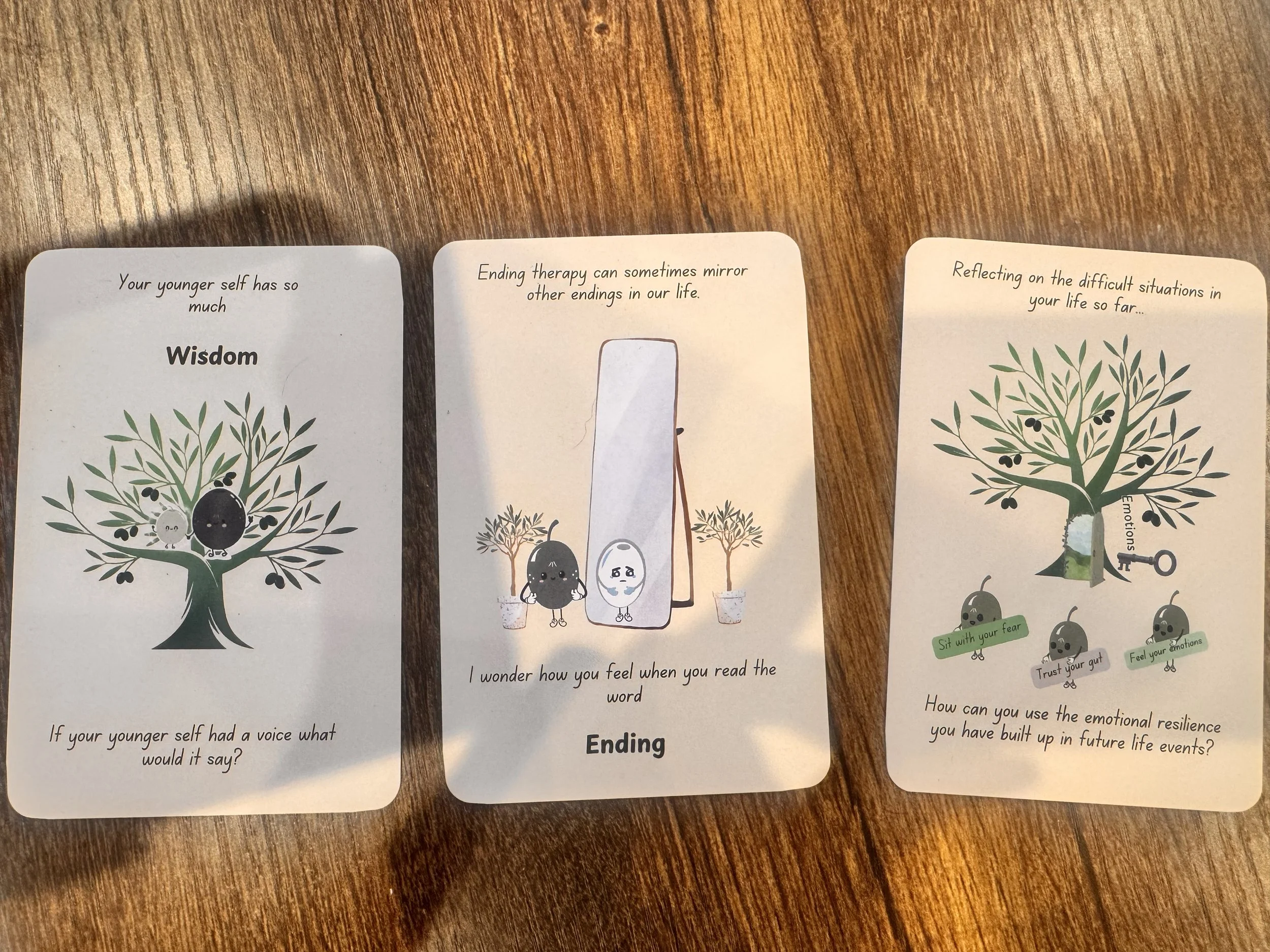
We used the brilliant Badass Affirmation Cards and Reflective Endings Cards to guide and prompt this exploration — both of which I highly recommend for clients and practitioners looking to bring more creativity and depth into their sessions.
🧡 Grab your own set of Badass Affirmation Cards (affiliate link – thank you for supporting my work!)
🔗 https://www.amazon.co.uk/dp/B0DRL7ST6B/?tag=louisemalya0d-21
🧳 Explore the beautifully designed Reflective Endings Cards
🔗 https://yourtimetherapy.uk/resources-&-training
💫 The Takeaway?
That there is beauty in us, even when it feels distant. And often, we find it not in logic, theory, or even words… but in unexpected items, silly memories, and play.
As soon as we found that moment of joy, we knew.
We remembered who we were.
We gave ourselves permission to go there.
And that’s the real work sometimes — giving ourselves permission to be fully human. Messy. Playful. Free.
🖌️ So What Now?
More play.
More joy.
More of doing things differently.
Whether you're a counsellor, creative, or someone who feels a little lost at the moment — maybe this is your reminder to pack your own suitcase. To revisit the parts of you that once brought life, laughter, and ease.
Because healing doesn’t have to be heavy.
Sometimes, it looks like colour.
Sometimes, it looks like connection.
Sometimes, it starts with a scribble on a page.
You can learn more about me and my approach here:
🔗 www.wildfirecounsellingtherapy.co.uk
📧 louisemalyancounselling@gmail.com
Let’s do therapy — and life — a little differently.
Because more play is always a good idea.
With warmth,
Louise x


Father’s Day and the Weight of Inner Child Wounds: You’re Not Alone
For many people, Father’s Day is not a celebration.
It’s not breakfast in bed, hugs from little ones, or reminiscing over warm memories.
It’s a day that quietly aches. That stings. That reminds us of the absence, the pain, or the complexity of a father figure who may have been hurtful, unavailable, emotionally distant — or not there at all.
You’re not being dramatic.
You’re not being over-sensitive.
And you are certainly not alone.
The Hidden Grief Behind the Smiles
Shops fill up with cards saying “Best Dad Ever.”
Social media floods with posts about incredible dads and treasured childhood memories.
And if this doesn’t match your experience, it can leave you feeling like something’s wrong with you.
Maybe you…
Never had a relationship with your father.
Felt unseen, unprotected, or even harmed by him.
Grew up walking on eggshells around his anger or silence.
Are grieving the father you wish you had.
Are trying to show up as a parent yourself, but are exhausted and overwhelmed by everything Father’s Day stirs up.
Whatever your story is — I see you.
You might feel a mixture of sadness, envy, shame, anger, fear… even numbness.
Those feelings are not wrong.
They’re not too much.
They’re the echoes of your inner child — the part of you that never got to feel safe, cherished, or validated by a parent.
And days like this can bring all that flooding to the surface.
How Trauma Shows Up in Adulthood
Inner child wounds don’t just disappear because we’ve grown up.
They show up in how we relate to others.
In the shame we feel for not being “enough.”
In the way we struggle to trust or to set boundaries.
In the burnout from constantly trying to keep it all together.
Maybe today, you feel like curling up and hiding from the world.
Maybe you’re trying to hold it together for your kids, your partner, your job — when inside, you feel broken or enraged or completely alone.
This kind of emotional pain is real.
And you don’t have to carry it on your own.
This Is Where Therapy Comes In
I offer a safe, compassionate, down-to-earth space where you can:
Gently explore the pain you’ve been carrying
Connect with and begin to heal your inner child
Understand your triggers and patterns in relationships
Release shame and start rebuilding self-worth
Learn to soothe your nervous system and lessen anxiety, anger, or burnout
Discover how to be more present — for yourself and for those you love
You don’t need to pretend it’s all okay.
You don’t need to know where to begin.
You just need to show up as you are — and we’ll go at your pace.
I know how painful it can be to feel like you’re carrying something no one else understands.
And I also know the power of being truly seen by someone who gets it.
You’re not broken. You’ve been wounded.
And wounds can heal — with the right care, time, and connection.
If this resonates, I invite you to get in touch.
I offer a free, no-obligation introductory video call so we can meet each other, and you can see if I feel like the right fit for you.
📧 louisemalyancounselling@gmail.com
🌐 www.wildfirecounsellingtherapy.co.uk
Take gentle care of yourself today.
Even if it’s just putting both feet on the floor and breathing.
You matter — even if it doesn’t always feel that way.
You are allowed to just exist and still be worthy.
